


Everyone knows about Nippori Fabric Town in Tokyo. Five floors of Tomato, eighty shops lining a single street, bolts of every fabric imaginable stacked to the ceiling. It’s a pilgrimage for sewers, and rightfully so. But here’s what most travel guides won’t tell you: if you care about Japanese textiles with real cultural depth, Kyoto is the city that matters.
Kyoto is where silk weaving was perfected for the Imperial court. Where shibori (絞り) tie-dyeing evolved into an art form passed down across generations. Where artisans still operate looms behind wooden machiya doors, just as they did centuries ago. And unlike Tokyo’s wholesale-oriented Nippori, Kyoto offers something you can’t get in a five-story building: the chance to understand, experience, and connect with the culture behind the cloth.
We’ve lived in Kyoto since 2022, running a Japanese fabric shop in central Nakagyō-ku. Visitors often ask us for recommendations: where to see real weaving, where to try dyeing, where to buy authentic fabric. Rather than giving them a rigid itinerary that depends on workshop reservations and train timings, we’ve put together this list of the spots that matter most. Pick the ones that interest you, combine them however you like, and build a textile day that fits your trip.
Key points
- Kyoto is the birthplace of Japanese textile traditions; this guide focuses on cultural spots (museums, workshops, restoration studios) rather than a fixed itinerary, so you can build the experience that fits your trip
- The Nishijin district (西陣) in northwest Kyoto is home to several textile museums and small galleries; two stand out as our top picks for first-time visitors, both offering different angles on the city’s 500-year weaving heritage
- Despite its name, the Nishijin Asagi Museum sits in central Kyoto near Shijō Karasuma, not in the Nishijin neighborhood itself; it’s named after the brocade technique on display rather than the geography, and it makes a much more accessible alternative for visitors short on time
- For hands-on experience, the Kyoto Shibori Museum is the only museum in Japan dedicated entirely to shibori dyeing, and runs workshops where you create and take home your own piece
- The Wakōhsha Sanjō workshop is a rare working studio in central Kyoto where you can briefly step in or watch from the street as artisans restore embroidered temple textiles between 100 and 300 years old, free of charge
- For buying authentic Japanese fabric by the meter, DIY District in central Nakagyō-ku offers a curated selection of wagara (和柄) cottons, all made in Japan and sourced directly from manufacturers
The Nishijin weaving district: two museums in Kyoto’s textile heart
The Nishijin district (西陣, nishijin) is the historic heart of Kyoto’s textile industry, located in the northwest of the city. This neighborhood has been the center of Japanese silk production since artisan weavers settled in the area after the Ōnin War (1467-1477). Walk these quiet streets in the early morning and you can still hear the rhythmic clatter of looms from behind wooden doors. Several textile museums and small galleries are scattered through Nishijin; the two below are our favorites for a first visit, and they’re within walking distance of each other.
Nishijin Textile Center (西陣織会館)
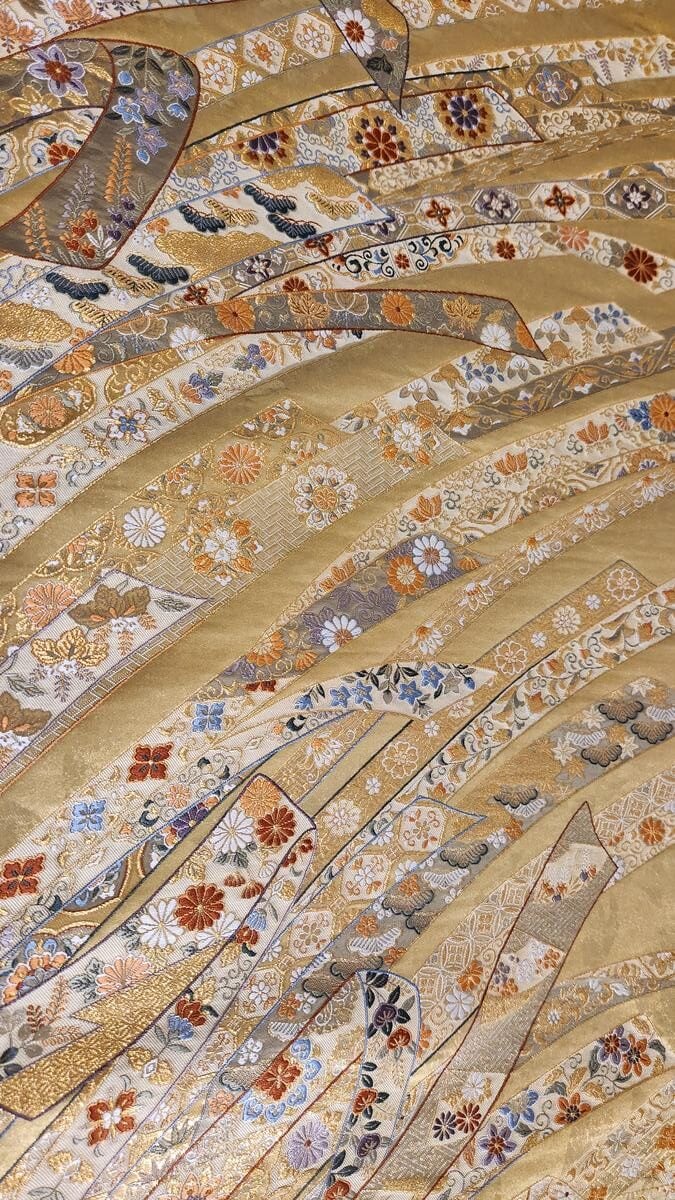
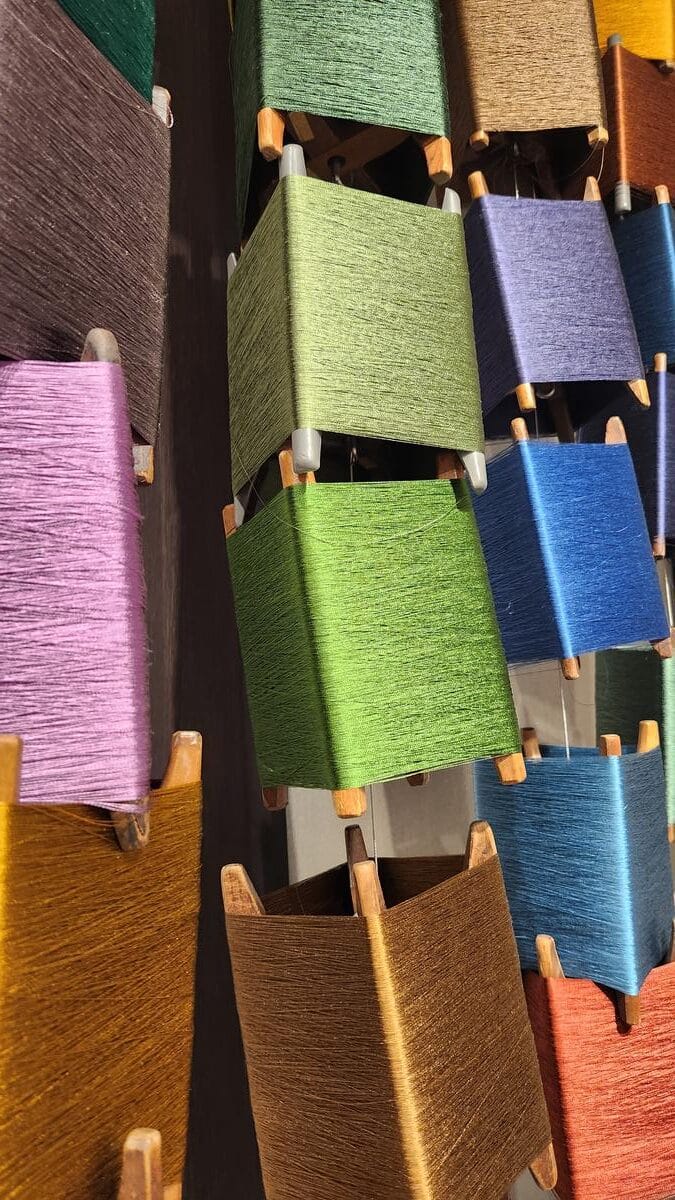
The Nishijin Textile Center (Nishijin-ori Kaikan) is the main public-facing institution dedicated to Kyoto’s weaving heritage. Admission is free and no reservation is needed. Inside, you can watch live demonstrations of traditional loom weaving: artisans work on massive Jacquard looms producing intricate obi sash fabric in real time. Exhibitions on the upper floors explain the differences between nishijin-ori (brocade), yūzen dyeing, and other Kyoto textile techniques. Finished kimono and obi are on display, from everyday wear to ceremonial pieces worth tens of thousands of dollars. The center also hosts regular kimono fashion shows.
It’s a great first introduction, especially if you’ve never seen Japanese weaving before. Some visitors find it slightly touristy, which is fair. Pair it with the next museum for a more atmospheric experience.
Practical: Free entry. Open Tuesday to Sunday, 10:00 to 17:00. Closed Mondays. No reservation needed. Karasuma subway line to Imadegawa Station, then 12 minutes on foot. Website: nishijin.or.jp.
Orinasu-kan Museum of Hand-Weaving (織成舘)
Orinasu-kan is the more atmospheric of the two. The museum is housed in a 1936 machiya (町家) that originally served as both home and workshop for the obi maker Watabun. Stepping inside feels like walking into the actual world of a Nishijin weaver’s family: tatami rooms, a central courtyard, wooden beams, the muted light of a traditional townhouse.
The collection is small but considered. Themed exhibitions rotate through traditional Noh costume reproductions, antique kimono, and woven fabrics and tools collected from textile regions across Japan. Visitors often mention being welcomed with a cup of tea and a wagashi sweet in the former living quarters before starting the visit, looking out onto the garden. It’s the opposite of a tourist trap, and it’s exactly the kind of slow, thoughtful experience that rewards anyone who genuinely cares about textiles. It’s high on our own list of places to visit next, and the surrounding Nishijin streets are some of the best in Kyoto for an unhurried wander.
Practical: ¥500 entry. Open Tuesday to Sunday, 10:00 to 16:00. Closed Mondays. Address : 693 Daikoku-cho, Jōfukuji-dōri Kamidachiuri-agaru, Kamigyō-ku. A short walk from the Nishijin Textile Center.
Nishijin brocade as art: the Nishijin Asagi Museum (西陣あさぎ美術館)
Despite its name, the Nishijin Asagi Museum is not actually located in the Nishijin neighborhood. It’s tucked away on the 7th floor of Tsukaki Square in central Kyoto, a one-minute walk from Shijō Station on the Karasuma line. The “Nishijin” in the name refers to the weaving technique on display, not the geography. For visitors who don’t have time to trek up to the actual Nishijin district, this museum is a much more central alternative.
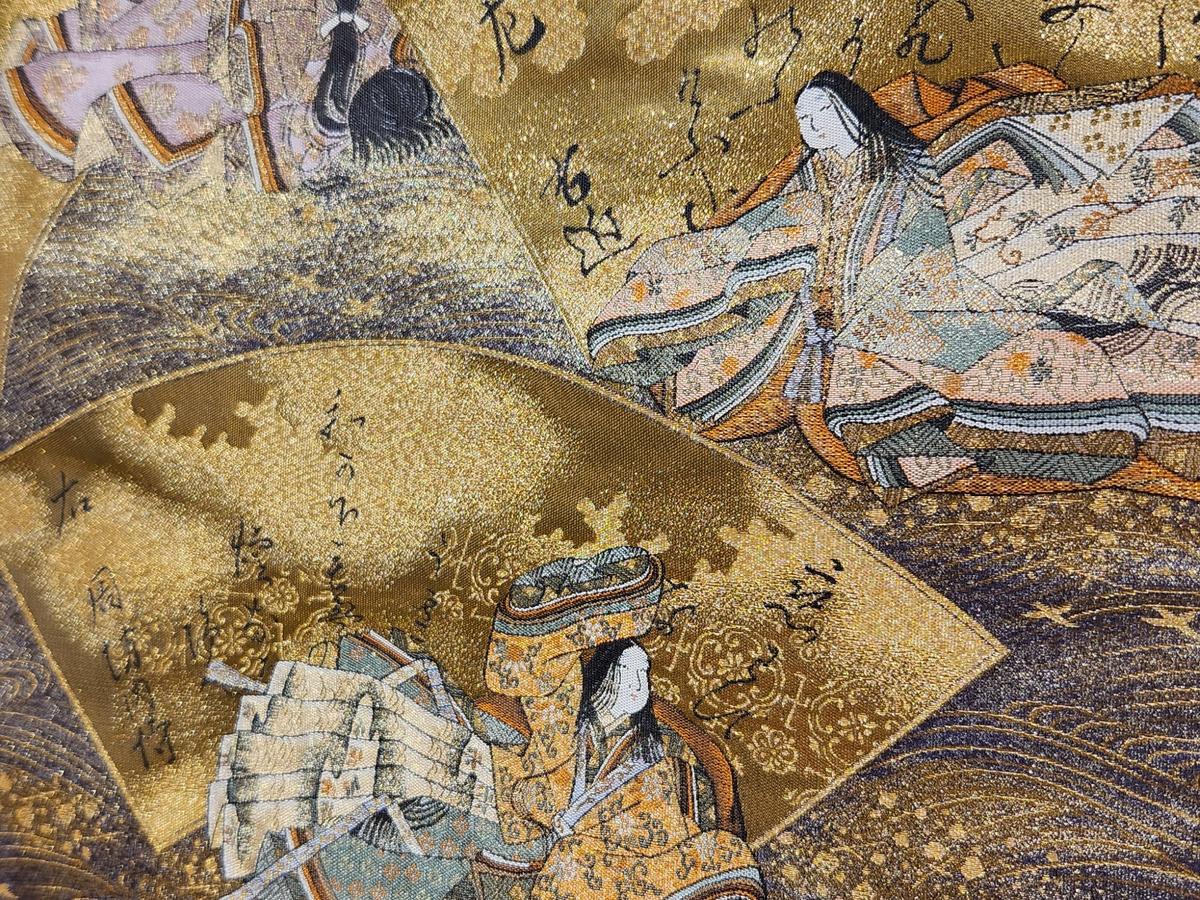
And it’s well worth the visit. This small museum showcases something extraordinary: masterpieces by Van Gogh, Monet, Hokusai, and other great painters, entirely reproduced in woven silk using an 1800-needle Jacquard loom. The level of detail is startling. Brushstrokes, color gradients, and light effects are rendered thread by thread, pushing the boundaries of what textile can express.
The museum also displays works inspired by Rinpa art, Buddhist paintings, and ukiyo-e prints. Some pieces use luminous yarns that glow in the dark. Free audio guides are available in English. Where the Nishijin Textile Center shows you how brocade is made, the Asagi Museum shows you how far that technique can go.
Practical: ¥500 entry. Open Tuesday to Sunday, 10:00 to 17:00 (last admission 16:30). Closed Mondays. Address : Tsukaki Square, 7th floor, Karasuma Bukkōji, Shimogyō-ku. One minute from Shijō subway station (Karasuma line, exit 6). Website: asagi-museum.jp.
Where to experience shibori: Kyoto Shibori Museum (京都絞り工芸館)
Shibori (絞り, shibori) is the traditional Japanese art of shaped-resist dyeing, with roots stretching back over 1,300 years to the Nara period (710-794). The Kyoto Shibori Museum (Kyoto Shibori Kōgeikan) is the only museum in Japan dedicated entirely to this technique, and it’s the single most rewarding stop for anyone who wants to understand dyeing rather than just look at it.
The museum is small, intimate, and run by a family of artisans who have been producing shibori at this location for over 80 years. Inside, you’ll find stunning large-scale shibori works on display, with special exhibitions that rotate every two months, plus a video explaining the various techniques (available in English, French, and several other languages). The exhibition alone takes about 30 minutes.
The real highlight is the hands-on workshop. You can book a session in advance and create your own shibori-dyed scarf or furoshiki wrapping cloth using traditional techniques like sekka shibori (snow crystal patterns), itajime shibori (plate-folded patterns), or kyo-arashi shibori, a technique unique to Kyoto. The staff guides you through every step, and you take your finished piece home the same day. It’s one of those rare travel activities where you leave with both a skill and a handmade souvenir.
After dyeing your own piece by hand, you’ll look at every printed cotton differently. Understanding how indigo bonds with fabric, how knots create patterns, how the fabric remembers the resistance, all of it changes the way you perceive Japanese textiles for the rest of your trip.
Practical: Exhibition entry ¥1,000. Workshop from ¥5,500 (includes museum admission). Open Monday to Friday, 9:00 to 17:00. Closed weekends. Reservation strongly recommended for workshops, especially in peak season. Address: Aburanokōji-dōri, south of Oike-dōri, Nakagyō-ku. 5-minute walk from our shop. Website: shibori.jp.
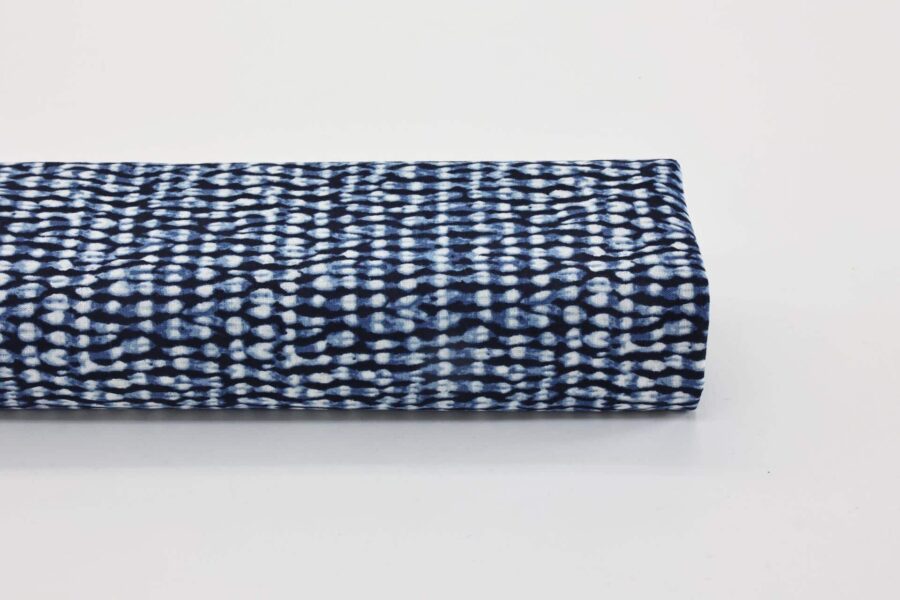
Japanese fabric with indigo Shibori print

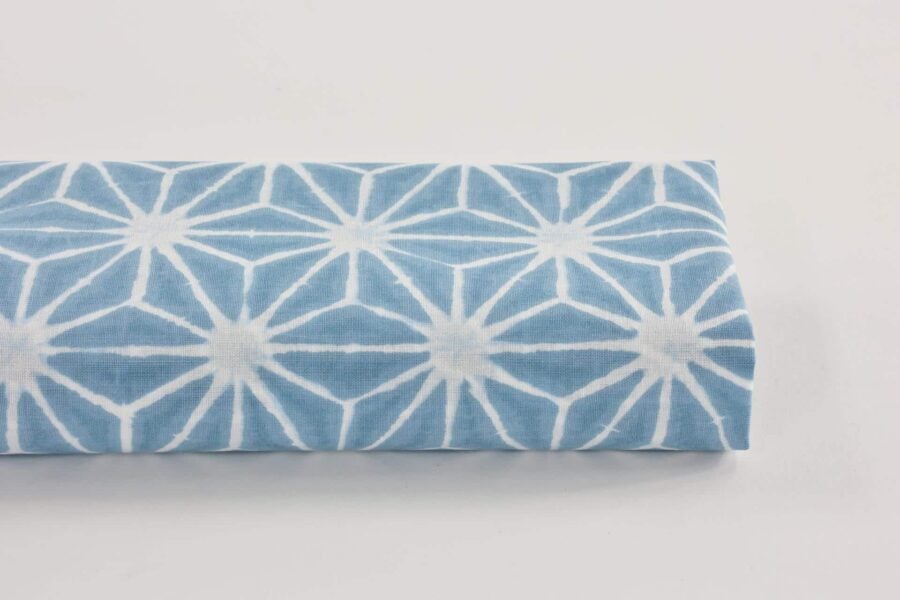
Asanoha Shibori white fabric blue background
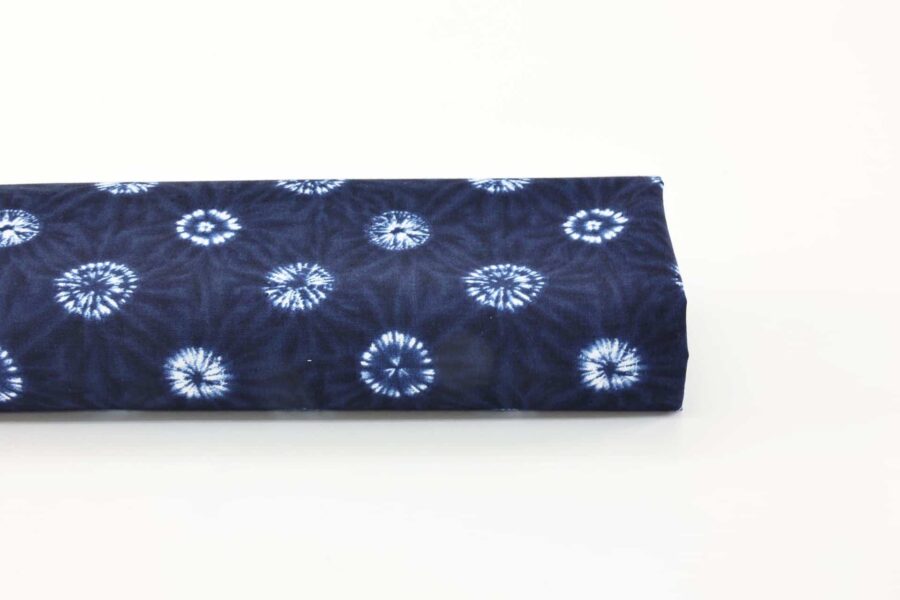
Japanese fabric indigo Kumo shibori style
A 200-year-old craft brought back to life: Kyoto Embroidery Restoration Studio
On Takakura-dōri just south of Sanjō-dōri, there’s a small glass-fronted workshop most travel guides miss. The Kyoto Embroidery Restoration Studio (京都刺繍修復工房, kyōto shishū shūfuku kōbō), part of the Wakōhsha company, restores embroidered altar cloths from Buddhist temples across Japan, some of them 100 to 300 years old. The full glass facade is intentional: passersby can watch the artisans at work from the street, and you can step inside for a moment if you want a closer look.
It’s not really a destination, more a quick detour worth making if you’re already nearby. A glance through the window at someone working a needle through silk older than your grandparents is the kind of small Kyoto moment that sticks with you.
We walk past it regularly on our way home after our daughter school day, and even after seeing it dozens of times, a glance through the glass at someone working a needle through 200-year-old silk still stops us in our tracks.
Practical: Free, no reservation. Open Monday to Friday, 9:00 to 17:30. Takakura-dōri, just south of Sanjō-dōri, Nakagyō-ku. A 2-minute walk from the Museum of Kyoto. Website: wakohsha.com.
Where to buy Japanese fabric in Kyoto: DIY District
After visiting museums and watching artisans at work, you’ll want fabric for your own creative projects. Kyoto has plenty of options for fabric shopping, from large multi-floor stores with thousands of bolts to small specialty shops, each with its own appeal. What we offer is simply a different approach.
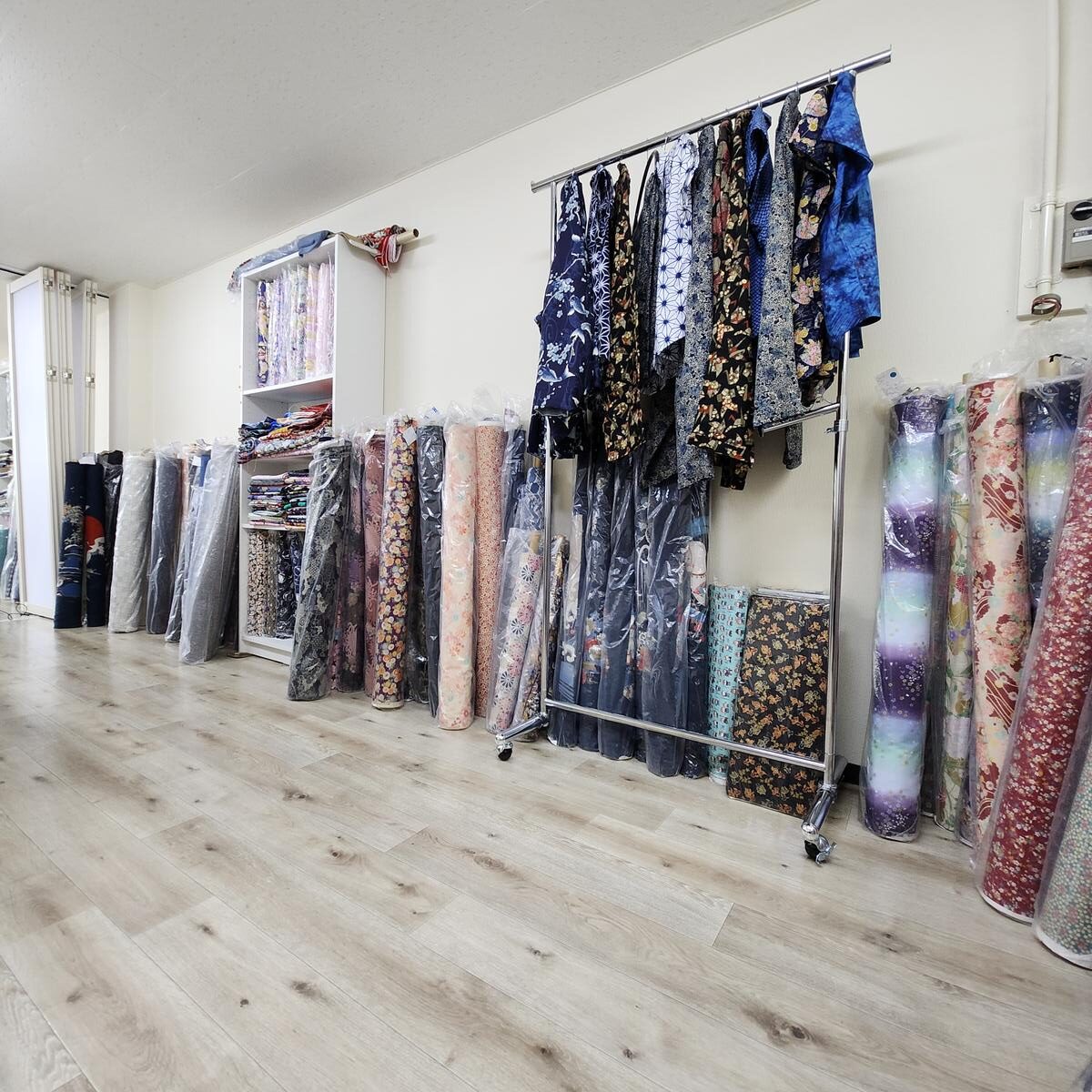
DIY District is a fabric store in central Kyoto (Nakagyō-ku) with a single focus: wagara (和柄), authentic Japanese patterns, made in Japan. Our collection holds over 500 fabrics, all sourced directly from manufacturers across the country, with nothing else in the mix. If you want choice and variety across every possible material, the bigger stores are the better fit. If you want a room where every fabric is made in Japan and we can tell you the story behind each pattern, we’re the right stop.
Our collection spans traditional wagara prints like Asanoha (麻の葉, hemp leaf) and Seigaiha (青海波, ocean waves), nature-inspired Sakura (桜) designs, cranes, and Mount Fuji motifs. For something more playful, we carry kawaii prints with Maneki-neko (lucky cats), Shiba Inu, and sushi motifs, as well as bold manga-inspired fabrics. On the textured side, we stock Kobayashi dobby cottons with a tactile quality you can only appreciate by touching them, chirimen (ちりめん) traditional crepe fabric, Nani Iro designer organic cotton, and silk brocade for statement pieces.
What we hear from visitors who come in after a morning of museums and workshops: that’s when the textile day clicks into place. Suddenly you’re not just looking at fabric. You’re recognizing the Asanoha pattern from the temple you visited that morning, the indigo from the shibori workshop, the brocade weave from the Asagi Museum. The cultural context turns into something tangible you can take home.
We’re also a small family of textile enthusiasts who moved to Kyoto because we fell in love with Japanese fabric culture. Customers often stay for a conversation about their trip, our favorite spots in Kyoto, the history behind a specific pattern. It’s a different kind of fabric shopping experience, and it’s exactly why we built the store this way.
Practical: Open Monday to Friday, 8:30 to 17:00. Closed weekends. 3rd floor of Kitagawa Building, Nishinotōin-dōri, just south of Rokkaku-dōri, Nakagyō-ku. A short walk from Nishiki Market. English, French, Japanese spoken. Cash, credit cards accepted. Website: diydistrict.com.
Bonus: vintage kimono at Kyoto’s monthly flea markets
If your visit happens to fall on the right date, Kyoto’s temple flea markets are a fantastic addition to a textile-focused trip. They only happen once a month each, but if the timing works, they offer something the museums can’t: the chance to handle and buy real vintage kimono, obi sashes, and antique textile fragments at very modest prices.
Tōji Temple flea market (東寺弘法市): every 21st
The Kōbō-ichi (弘法市) at Tōji Temple is one of Kyoto’s most iconic markets. Hundreds of vendors spread out across the temple grounds, selling everything from antique ceramics to handmade pickles. For textile lovers, the real draw is the vintage kimono and obi section. You’ll find vintage obi sashes with stunning woven or embroidered designs, bolts of old kimono fabric perfect for upcycling, plus furoshiki wrapping cloths and tenugui hand towels.
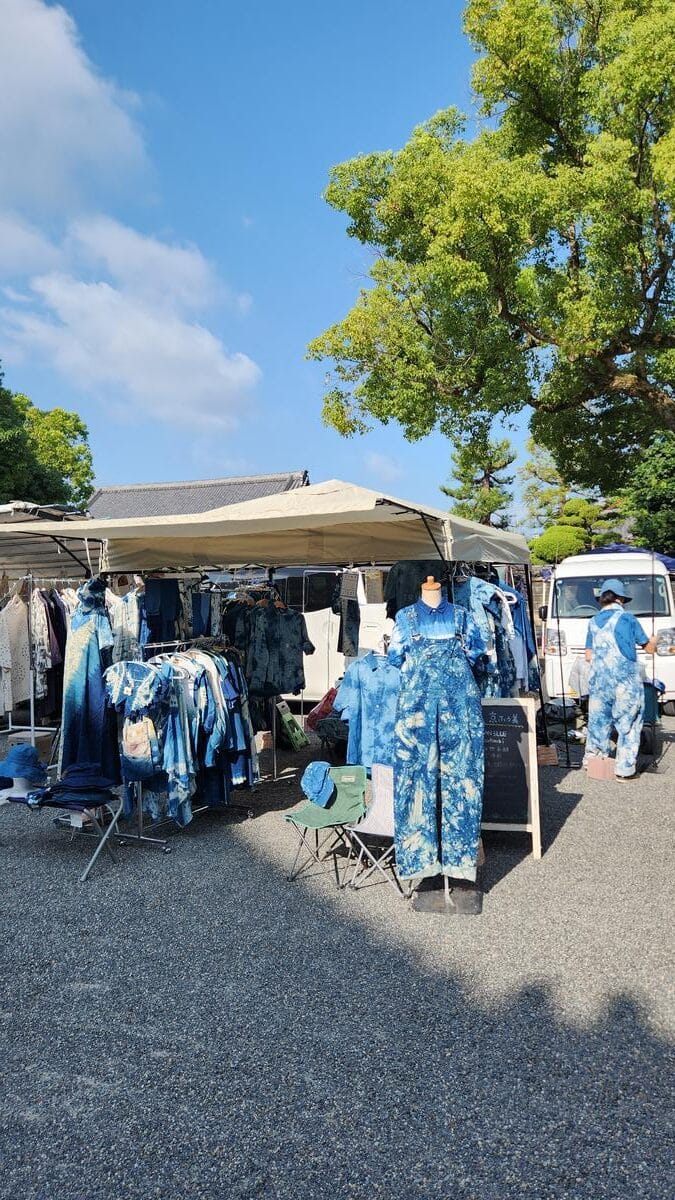
Not everything at Tōji is vintage, though. On one visit, we stumbled on a stall where every single piece of clothing was dyed in indigo shibori: jumpsuits, jackets, hats, even the vendor’s own outfit. It was a good reminder that shibori in Kyoto isn’t just a museum tradition. It’s a living craft, and it shows up in places you don’t expect.
Kitano Tenmangū (北野天満宮天神市): every 25th
A similar flea market, slightly smaller but just as charming, with a good selection of vintage textiles and antiques. Conveniently located in the Nishijin area, so it pairs naturally with a visit to the weaving museums.
Tips for flea market shopping
Arrive early. The best pieces go fast, and serious collectors are there by 7 AM. Bring cash in yen; most vendors don’t accept cards. And don’t be afraid to dig through the piles. Some of the most beautiful fabrics are buried under stacks of ordinary ones.
One important note: flea market kimono are genuine vintage pieces, often decades old. They may have minor stains, fading, or wear. That’s part of their character. They’re collector’s items and upcycling material, not new fabric for sewing projects.
What about Tokyo? Nippori Fabric Town in comparison
If your Japan itinerary also includes Tokyo, Nippori Fabric Town (日暮里繊維街, nippori sen’igai) deserves a half-day of its own. This roughly one-kilometer stretch near Nippori Station is home to over 80 fabric shops, with Tomato as the undisputed anchor: five floors of fabric covering everything from basic quilting cotton to imported European lace, Korean synthetics, jersey, lycra, and more.
Nippori is ideal for volume and variety. If you need 15 different fabrics for a complex project and want to compare options across every possible material, it’s unbeatable. The main Tomato building alone holds five floors and thousands of bolts, and reviews consistently describe the experience as overwhelming. As one TripAdvisor visitor warned, it’s a place to visit only if “your travelling companion is patient and tolerant.” Plan for several hours, and maybe leave the non-sewers at a nearby café.
Where Nippori is a wholesale market that sells everything to everyone, Kyoto offers depth instead of breadth. The museums, the shibori workshop, the embroidery restoration studio, all of it builds a context that no Tokyo fabric district can replicate. Both cities are worth your time. Tokyo for the adrenaline of choice, Kyoto for the depth of meaning.
A few practical tips for planning your day
The Kyoto Shibori Museum workshop is the only stop that requires advance booking, so build the rest of your day around that reservation. Most other spots are closed on Mondays, so plan for Tuesday through Sunday if possible. Allow roughly 45 minutes per museum, 90 minutes for the shibori workshop, a quick stop at the embroidery studio if you happen to pass by, and however long feels right at DIY District.
Have you explored Kyoto’s textile side, or is this trip still in the planning stage? We’d love to hear about your experience. And if you can’t make it to Kyoto just yet, our full collection of Japanese fabrics ships worldwide from our Kyoto store.