

Of all the traditional Japanese patterns printed on fabric, seigaiha might be the most quietly hypnotic. Rows of concentric half-circles, layered like the crests of a perfectly calm sea, repeating endlessly in both directions. The effect is meditative. Rhythmic. Once you notice it, you start seeing it on everything: kimono, ceramics, Zen garden gravel, even the uniforms of the Japanese rugby team.
The seigaiha pattern (青海波, seigaiha) translates literally to “blue ocean waves.” Three kanji, one image: 青 (blue), 海 (ocean), 波 (wave). But the story behind this motif stretches far beyond the Japanese coastline. Seigaiha didn’t originate in Japan. It traveled thousands of kilometers along the Silk Road, from Sassanid Persia through Tang dynasty China, before reaching the imperial courts of Kyoto over 1,400 years ago. And its name? It doesn’t come from the sea at all, but from an ancient court dance where performers wore robes embroidered with waves.
That’s a lot of history packed into a simple geometric pattern. And if you’re here because you love Japanese fabrics or you’re thinking about your next sewing project, there’s a practical side to this story too.
Key takeaways
Before diving into the details, here’s what you need to know:
- The pattern itself: Seigaiha (青海波) means “blue ocean waves” and is built from overlapping concentric half-circles arranged in staggered rows, one of the most recognizable geometric designs on Japanese fabrics
- Its origins: The motif originated in Sassanid Persia and reached Japan via the Silk Road during the Kofun period (3rd to 6th century), making it over 1,400 years old on Japanese soil
- The name: It doesn’t come from the sea but from a gagaku court dance called Seigaiha, famously described in The Tale of Genji (c. 1000 CE)
- Why it matters: Seigaiha is a kisshōmonyō (auspicious pattern) representing eternal peace, good fortune, and resilience, a favorite for weddings and celebrations
- Beyond fabric: The same wave motif appears in Zen garden sand raking (samon), Edo-period lacquerware, ceramics, and even the 2019 Rugby World Cup uniforms
- For sewers: Seigaiha fabric works well for quilting, bags, furoshiki, cushions, and Japandi-style home decor; match pattern scale to project size
- Best starting points: Classic indigo quilting cotton for traditional projects, kawaii mashups (Maneki Neko, Shiba) for playful accessories
What is the seigaiha pattern?
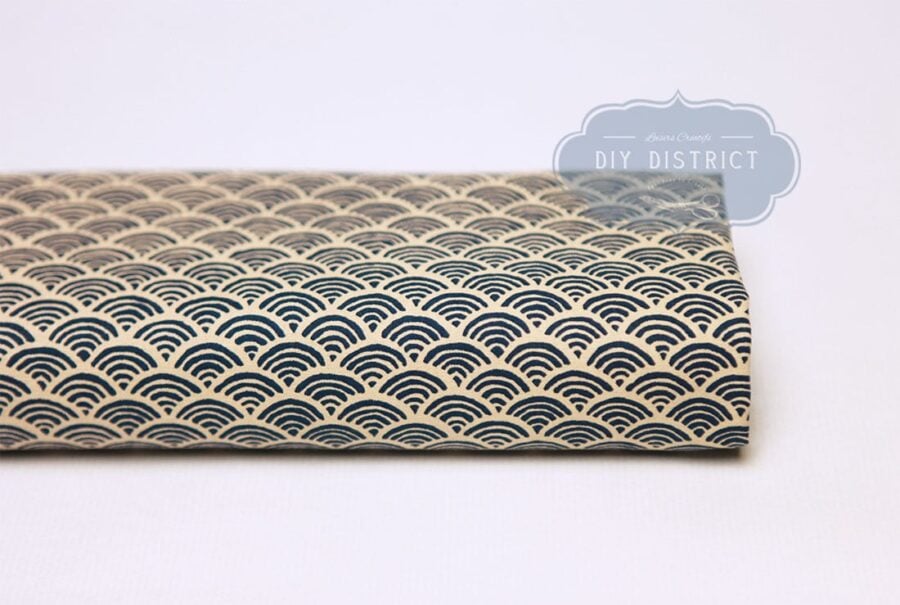
The seigaiha pattern is a traditional Japanese geometric design made of layered concentric arcs. Each unit consists of three or four nested half-circles, and these units are arranged in overlapping rows so that the visible portions form a continuous wave-like surface. The lower row partially covers the upper one, creating arches that resemble the crests of calm ocean waves seen from above.
How the pattern is built
Think of it this way: draw a half-circle. Add two or three smaller half-circles inside it, like the rings of a target cut in half. Now repeat that shape across an entire row, then offset the next row by half a unit so the arcs overlap. The result is a seamless, undulating surface with no beginning and no end.
This geometric simplicity is part of what makes seigaiha so versatile. Unlike figurative motifs (cranes, cherry blossoms, dragons), seigaiha is abstract enough to work as a background pattern, a main design element, or a supporting motif combined with other imagery. Japanese textile designers have paired it with cranes, rabbits, cats, fish, and flowers for centuries.
Three kanji, one meaning
The name is written 青海波: 青 (sei/ao, blue), 海 (kai/umi, ocean), 波 (ha/nami, wave). “Blue ocean waves.” In practice, seigaiha fabrics come in every color imaginable, from classic indigo and white to red, mustard, green, and even metallic gold. But the name keeps its connection to the sea.
You might also see the romanization seikaiha, which reflects an alternative reading of the same kanji. Both spellings refer to the same pattern.
From Persia to Japan: a Silk Road journey
Most people assume seigaiha is purely Japanese. It isn’t. The pattern has one of the most fascinating origin stories in textile history, one that spans three continents and more than a millennium.
Ancient roots in Persia and beyond
Similar concentric arc patterns have been found on artifacts from ancient Egypt, Turkey, and Sassanid Persia (224 to 651 CE). The Sassanid Empire, centered in modern-day Iran, was one of the ancient world’s great cultural crossroads. Its decorative motifs, carried by merchants and diplomats along the Silk Road, influenced art and textiles across Central Asia, China, and eventually East Asia.
The prevailing theory among Japanese textile historians is that the seigaiha motif traveled this route: from Persia through Central Asia into Tang dynasty China (618 to 907), where it was used to represent the sea on geographical maps. Chinese cartographers painted layered arcs to indicate ocean areas, a convention that would eventually give the pattern its distinctly aquatic identity.
Kofun period haniwa: the earliest trace in Japan
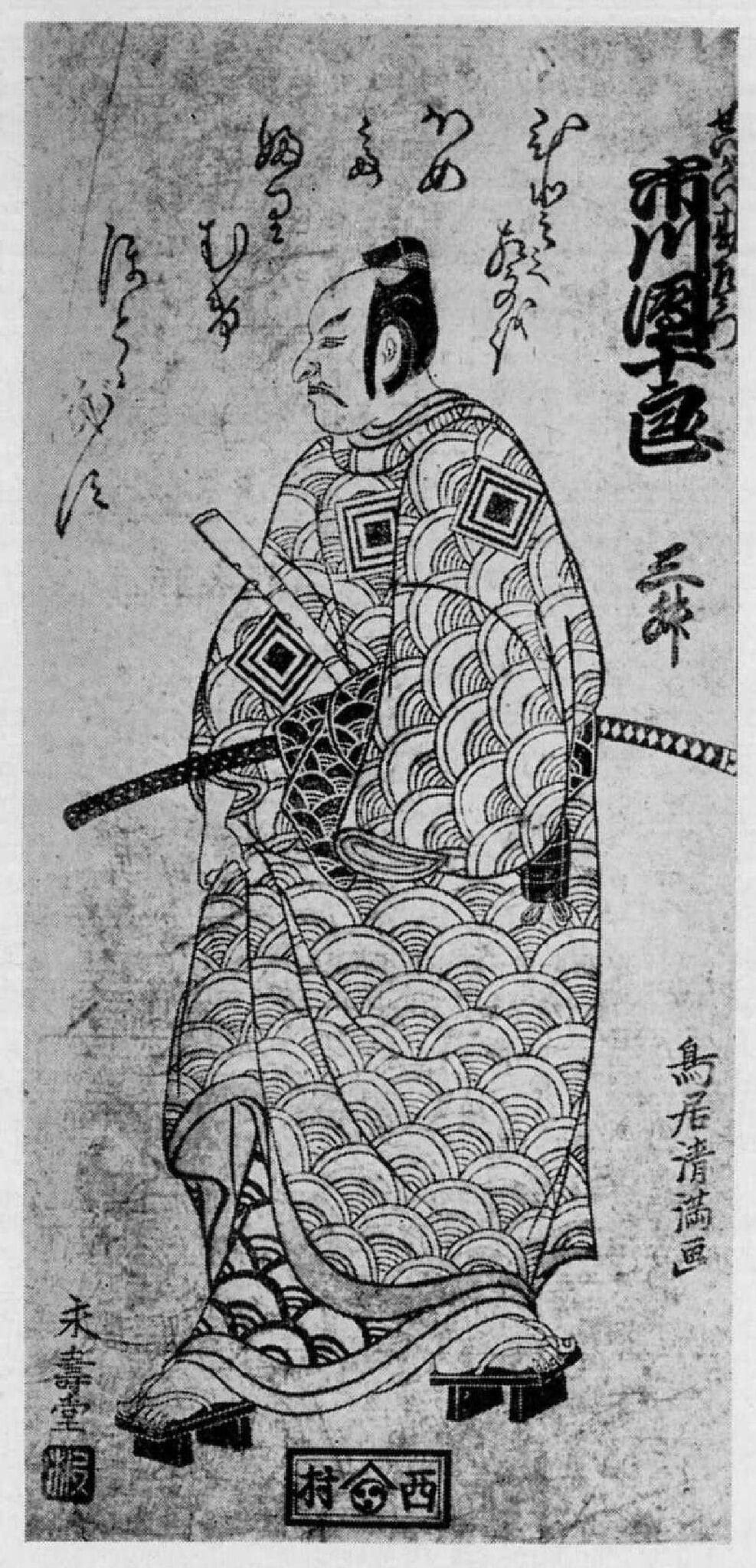
The oldest known appearance of a seigaiha-like pattern in Japan dates to the Kofun period (roughly 3rd to 6th century). It was found on the clothing of haniwa (埴輪), unglazed terracotta figures placed in burial mounds alongside the deceased. These figures, often depicting warriors, nobles, and dancers, offer some of the best visual evidence of early Japanese clothing. And at least one of them wears something that looks remarkably like seigaiha.
From Nara to Heian: a pattern enters the court
By the Nara period (710 to 794), cultural exchange between Japan and Tang China was at its peak. The Shōsōin (正倉院), the imperial repository in Nara that preserves thousands of 8th-century artifacts, contains textiles with geometric patterns that echo Silk Road influences, including wave-like motifs. Japanese weavers and dyers during this period were absorbing techniques and designs from across the continent.
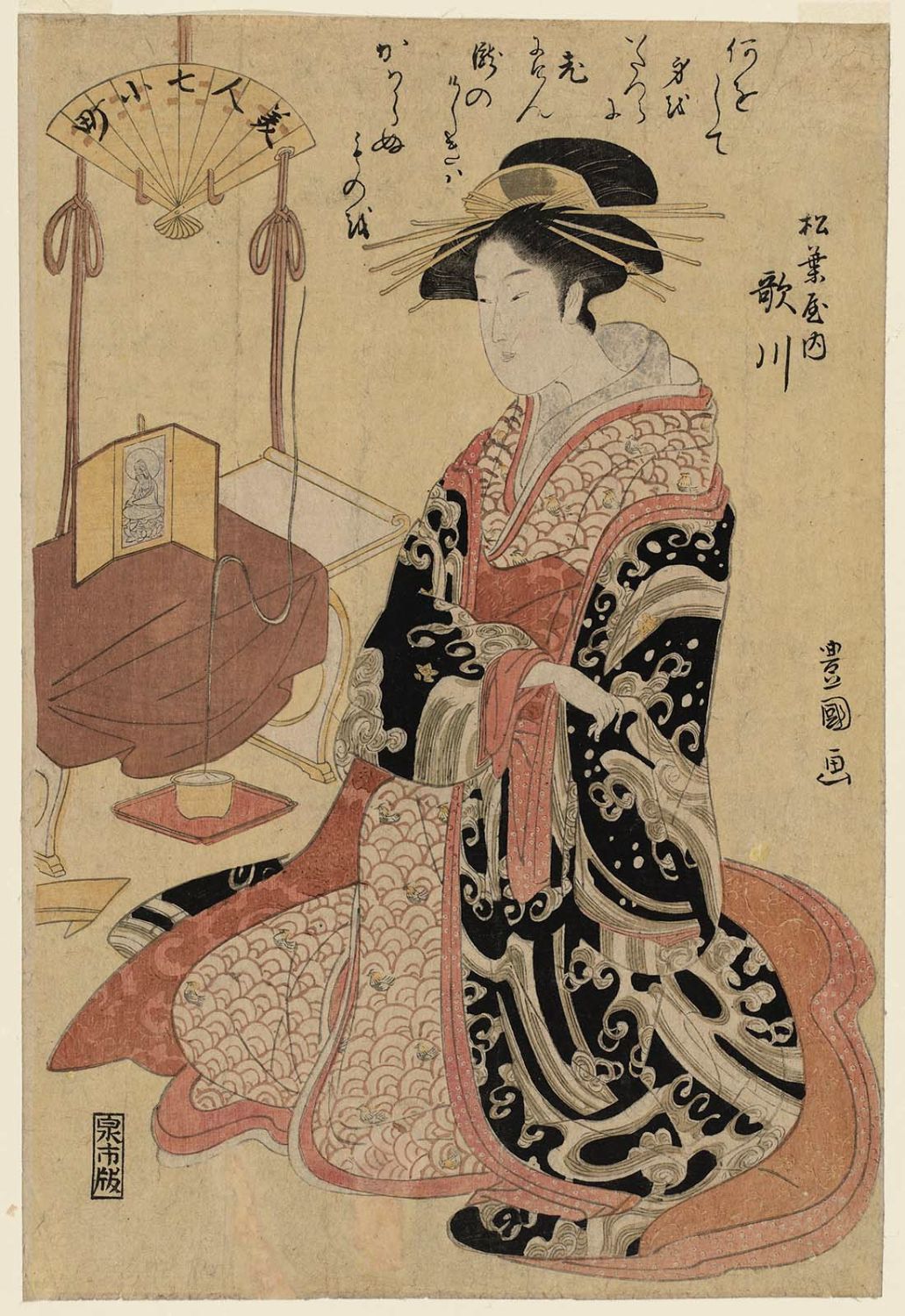
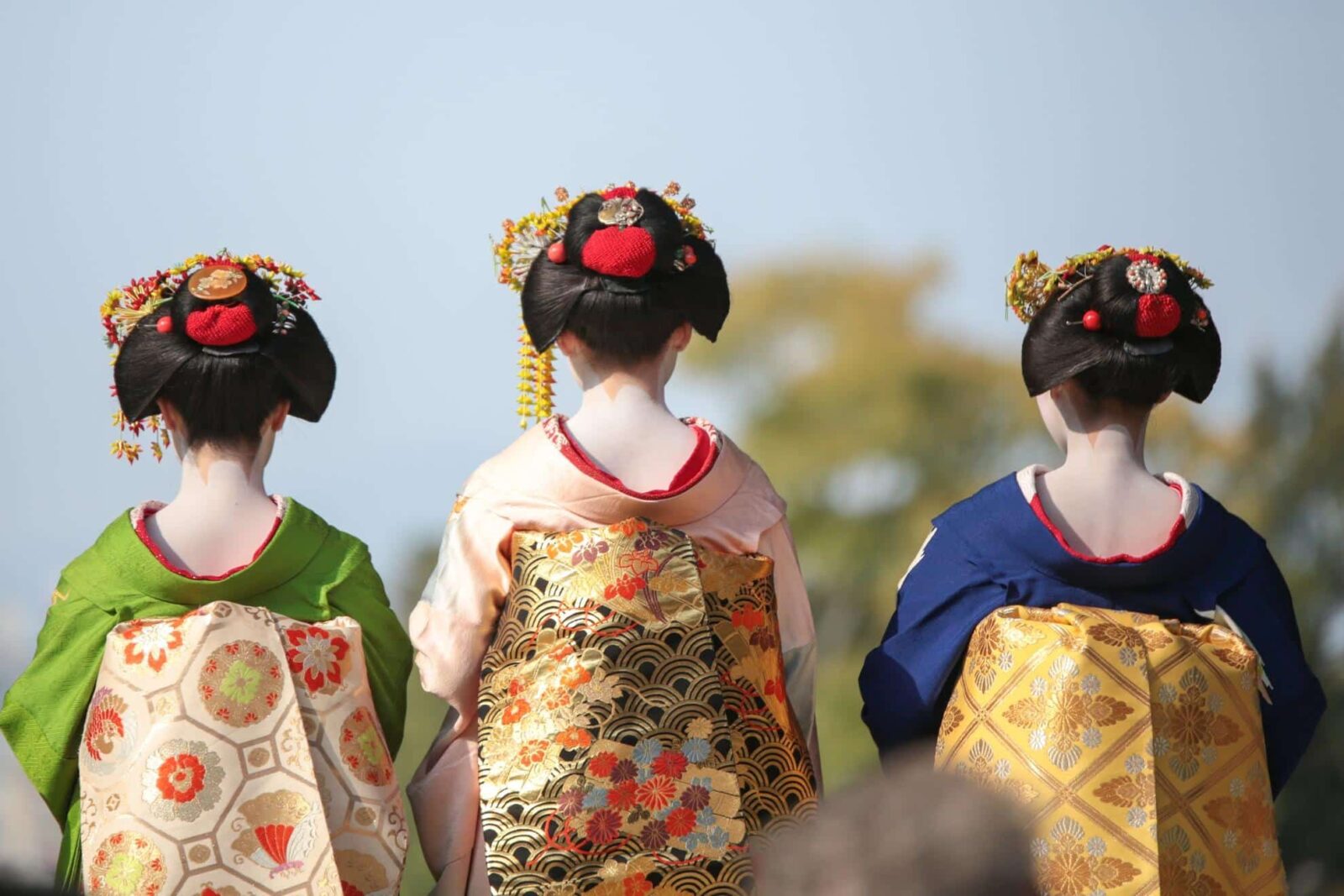
During the Heian period (794 to 1185), seigaiha found its way onto the elaborate layered robes of the aristocracy. It appeared on the shitagasane, a long trailing garment worn as part of the jūnihitoe (十二単), the twelve-layered ceremonial dress of court women. This was no longer a borrowed motif from foreign maps. Seigaiha had become Japanese.
The court dance that named a pattern
Here’s the part of the seigaiha story that almost nobody develops, and it’s arguably the most interesting. The pattern didn’t get its name from the sea. It got its name from a dance.
Gagaku: the world’s oldest orchestral tradition
Gagaku (雅楽, “elegant music”) is Japan’s ancient court music and dance tradition, inscribed on UNESCO’s Intangible Cultural Heritage list since 2009. Its roots reach back to the 7th century, when musical traditions from China, Korea, and, further west, Persia, India, and Central Asia were brought to Japan along the Silk Road. As one contemporary gagaku musician has put it, if you ask where this music began, the only honest answer is “somewhere along the Silk Road.”
Gagaku encompasses instrumental pieces, vocal songs, and dances called bugaku (舞楽). Among these bugaku pieces is one called Seigaiha, “Blue Ocean Waves.”
The dance itself
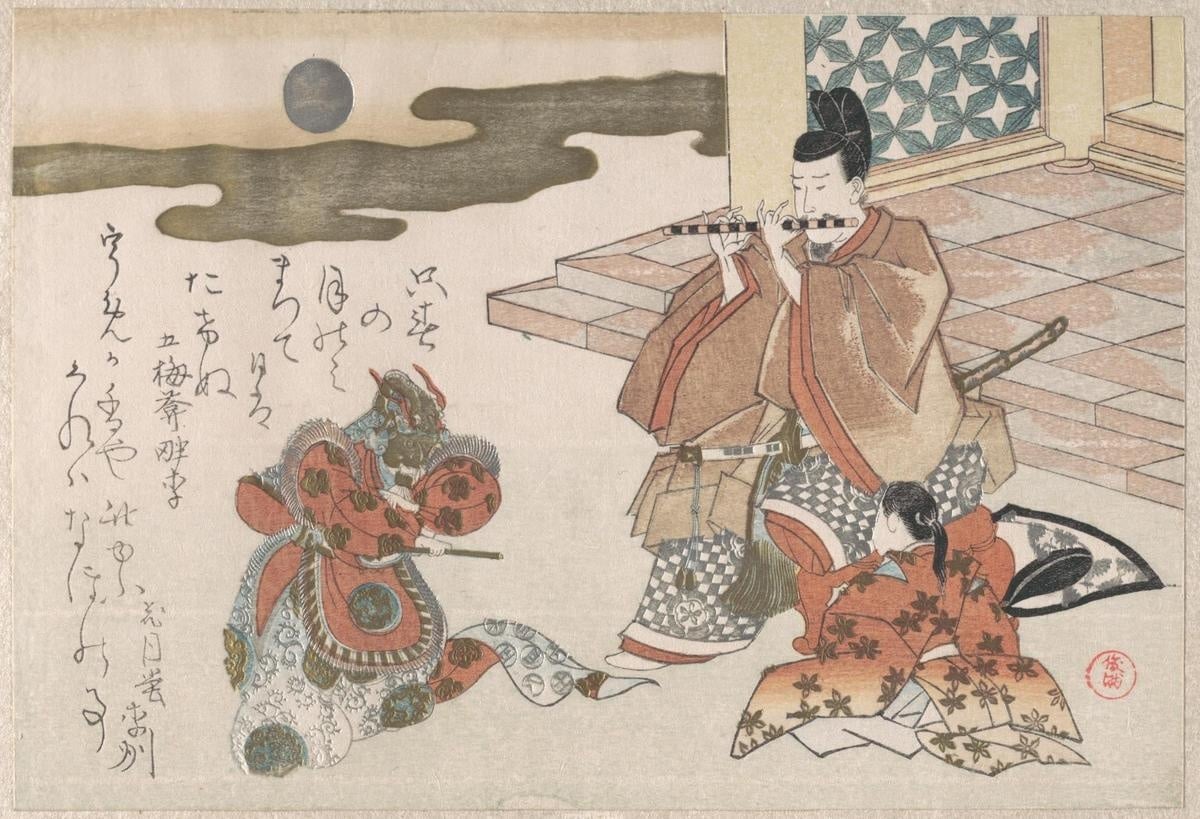
Seigaiha is a futarimai (二人舞), a dance performed by two dancers in the sahō (left side) tradition, which covers pieces of Chinese and Indian origin. It is played in banshikicho (盤渉調), a gagaku scale similar to the Dorian mode on B. The companion dance, performed simultaneously, is Shikite, a piece originally from Bohai (a medieval kingdom in what is now northeastern China and Korea).
The two dancers wear flowing robes decorated with wave motifs, and the choreography features slow, sweeping sleeve movements meant to evoke the rolling of ocean waves. Gagaku performances are deliberate, almost impossibly slow by modern standards. Every gesture is calculated. The effect, for anyone watching, is something like seeing time itself slow down.
Momiji no Ga: the famous scene from The Tale of Genji
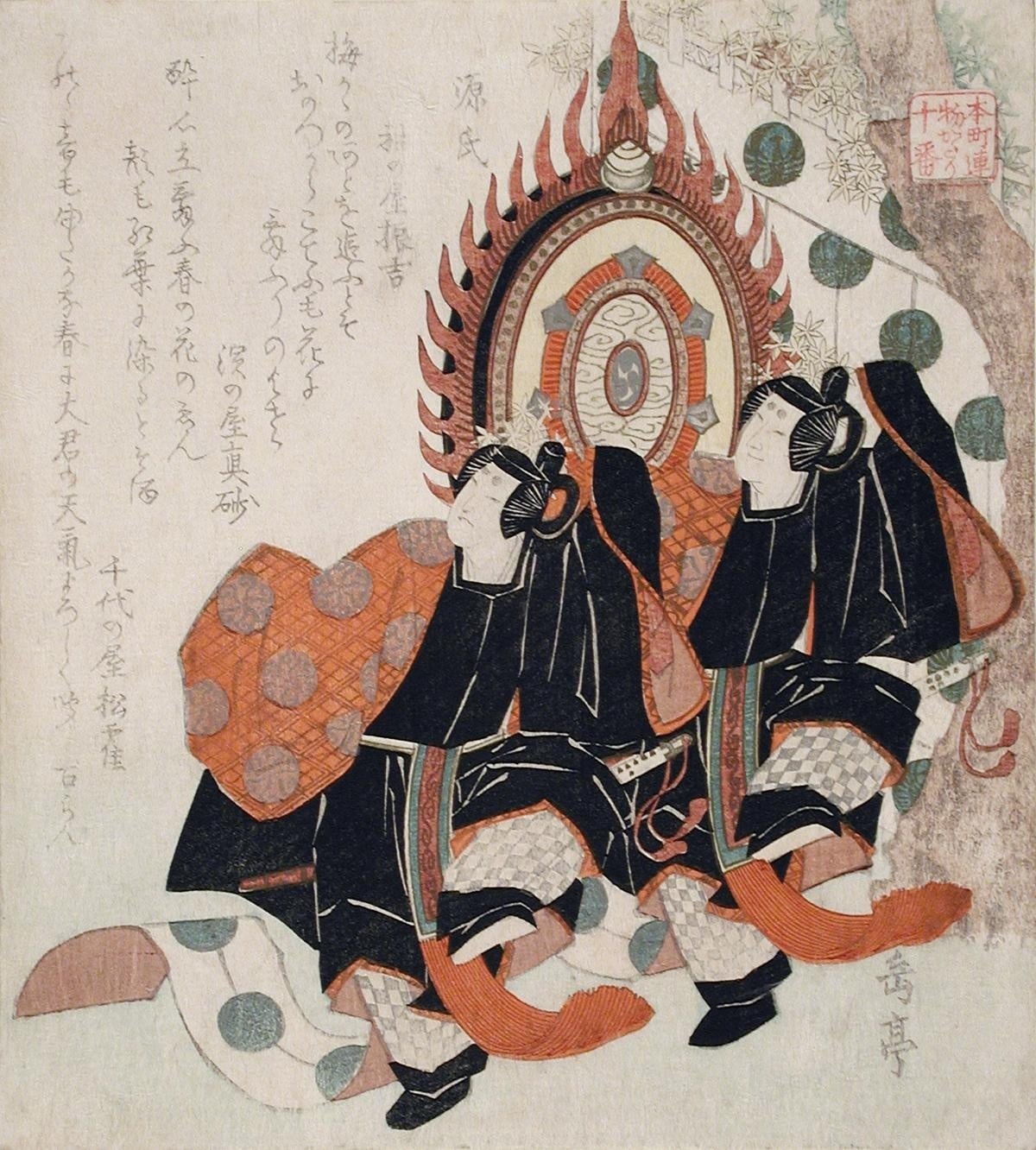
The most celebrated literary reference to the seigaiha dance appears in Genji Monogatari (源氏物語, The Tale of Genji), written by Murasaki Shikibu around 1000 CE. In Chapter 7, Momiji no Ga (紅葉賀, “Beneath the Autumn Leaves”), the protagonist Hikaru Genji and his friend and rival Tō no Chūjō perform the seigaiha dance before the emperor and his court.
Murasaki Shikibu describes how Genji emerges from among the falling autumn leaves, his beauty so striking that the spectators are moved to tears. The autumn leaves on his headdress fall as he dances, and attendants replace them with freshly picked chrysanthemums. It’s one of the most famous passages in all of Japanese literature, and it permanently linked the seigaiha motif to ideas of beauty, refinement, and courtly elegance.
If you’re curious about another pattern that connects to Japan’s literary and artistic traditions, the asanoha (hemp leaf) pattern has its own fascinating story involving kabuki theater and the Edo period.
Symbolism: what seigaiha means
Seigaiha belongs to a category of Japanese motifs called kisshōmonyō (吉祥文様), auspicious patterns believed to bring good fortune. And the symbolism is layered, much like the pattern itself.
Eternal peace and continuous good fortune
The most common interpretation connects the endlessly repeating waves to a wish for eternal peace and uninterrupted happiness. Waves keep coming; they never stop. Applied to a kimono or a gift wrapping, seigaiha carries the message: may good things come to you without end.
This makes the pattern particularly popular for weddings, New Year celebrations, and other occasions where well-wishing is central. A seigaiha furoshiki (wrapping cloth) used to present a gift says something specific: “I wish you continuous, wave-like good fortune.”
Power and resilience
There’s a second, less gentle reading. The ocean is also a symbol of power and resilience. Waves are patient, relentless, and ultimately unstoppable. This aspect of seigaiha symbolism resonated with the samurai class during the Edo period (1603 to 1867), when the pattern gained wide popularity across social strata.
The four seas
Some scholars note that the typical seigaiha unit consists of four concentric arcs, and interpret this as a reference to the four seas surrounding Japan. Whether this interpretation is historical or a later invention is debated, but it adds another dimension to the pattern’s meaning: protection, enclosure, an island nation sheltered by its waters.
Sevenberry Seigaiha navy blue fabric 1M
Japanese fabric Ukiyoe Kanagawa wave blue background
Japanese fabric mustard-colored Seigaiha print
Beyond fabric: seigaiha in gardens, ceramics, and architecture
One thing that surprised me when I first started paying attention to seigaiha is how far it extends beyond textiles. The pattern appears in media you wouldn’t expect.
Zen gardens and the art of raking sand
If you’ve visited a karesansui (枯山水) dry landscape garden in Kyoto, you’ve probably seen seigaiha underfoot, literally. The samon (砂紋), the raked patterns drawn into the gravel of Zen temple gardens, include a variation called seigaihamon (青海波紋): tightly interlocking semicircles that resemble fish scales or, naturally, ocean waves.
The sand patterns in karesansui gardens are not permanent. Monks re-rake them every few weeks, counteracting the effects of rain, wind, and the occasional bird. There’s something fitting about the seigaiha motif appearing in a medium that requires constant renewal, as though even the representation of eternal waves must be rebuilt again and again.
Lacquerware and the Edo artisan
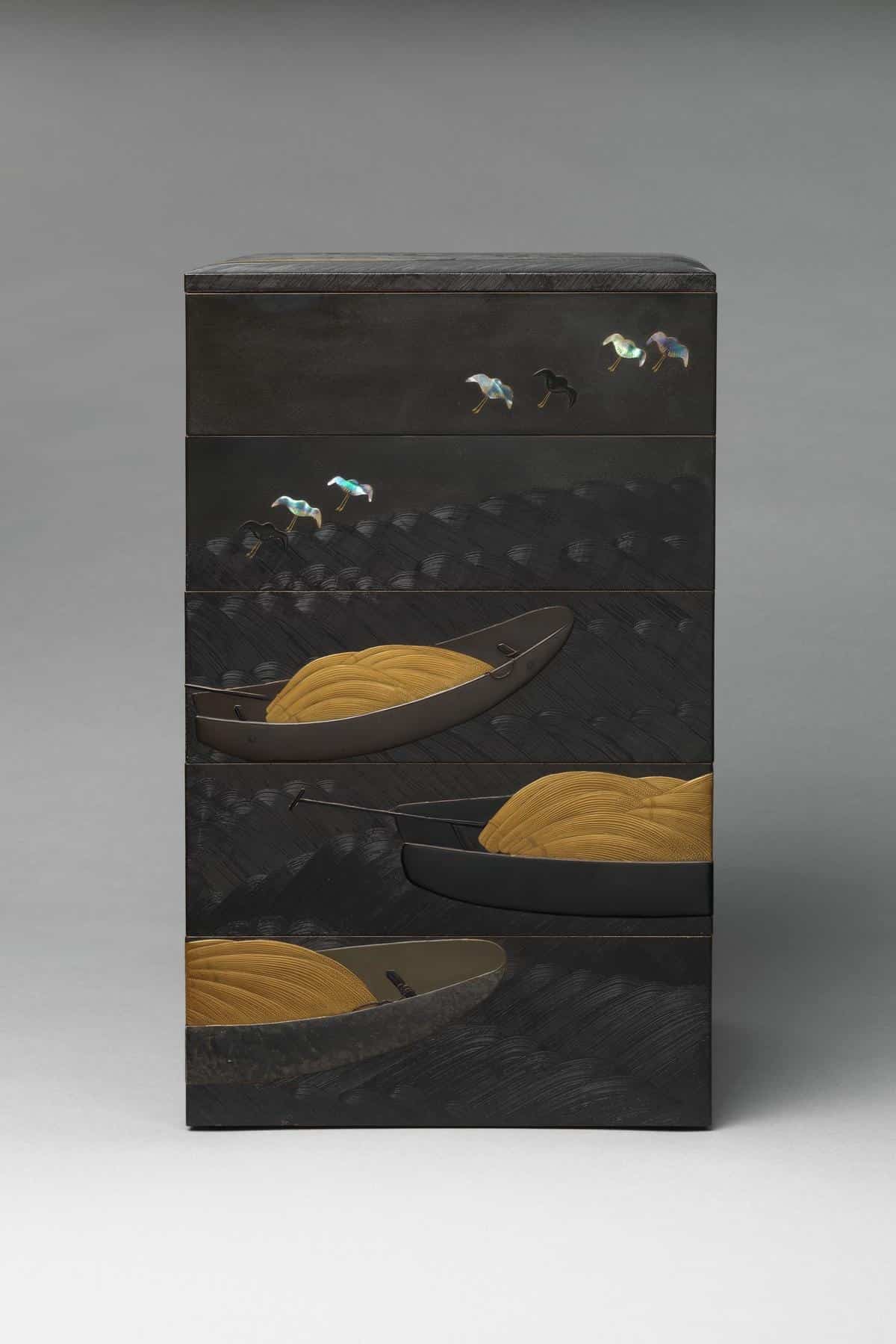
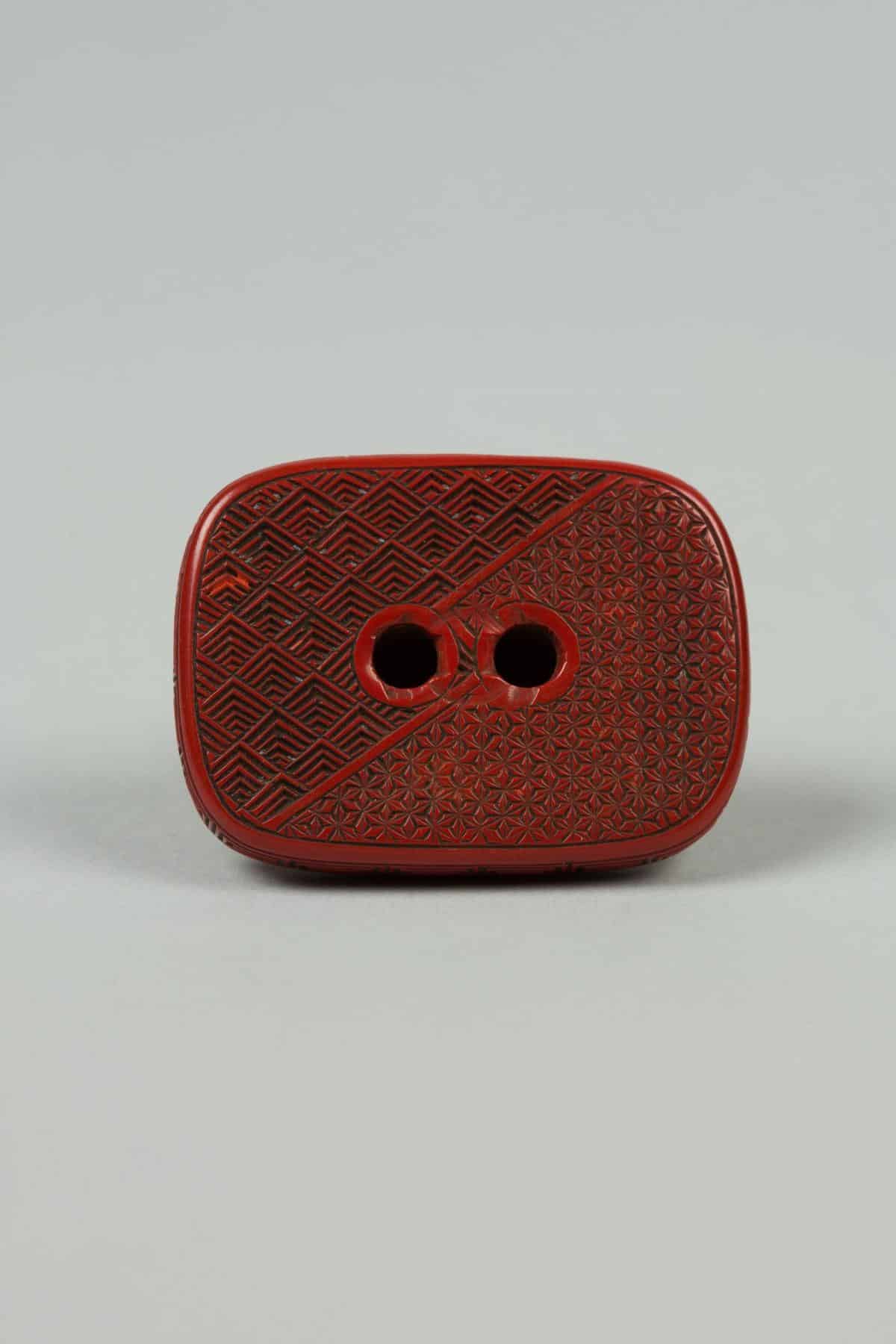
During the Edo period, a lacquerware artist named Seikai Kanshichi (清海勘七) became famous for his work with the wave pattern. He developed a technique for transferring the seigaiha design onto black lacquer using a special brush. Some historians believe the pattern’s name actually derives from his name rather than from the gagaku dance, though the dance theory is more widely accepted. Either way, Kanshichi’s work expanded seigaiha into a new medium and helped establish it as one of the defining decorative motifs of the Edo period.
Modern design
Seigaiha hasn’t stayed confined to traditional crafts. The pattern appeared on the official uniforms and merchandise of the Japanese national team at the 2019 Rugby World Cup, introducing the motif to a global sports audience. It shows up regularly in contemporary graphic design, interior decoration, packaging, and fashion, both in Japan and internationally. Its geometric regularity makes it easy to scale, tile, and adapt to digital contexts.
Seigaiha and other Japanese wave patterns
Japan has a rich vocabulary of wave motifs, and they’re not interchangeable. Mixing them up is a common mistake, especially in Western design contexts where “Japanese waves” tends to be treated as a single category. The differences matter, both aesthetically and culturally.
Nami: the naturalistic wave
Nami (波) simply means “wave” in Japanese, and as a textile motif, it refers to naturalistic, flowing wave designs. Unlike seigaiha’s geometric regularity, nami waves are organic, asymmetric, and dynamic. They curve, crash, and swirl. You’ll find nami motifs on fabrics featuring cranes flying over turbulent seas, or golden carps swimming through surging waves.
Aranami: the rough wave
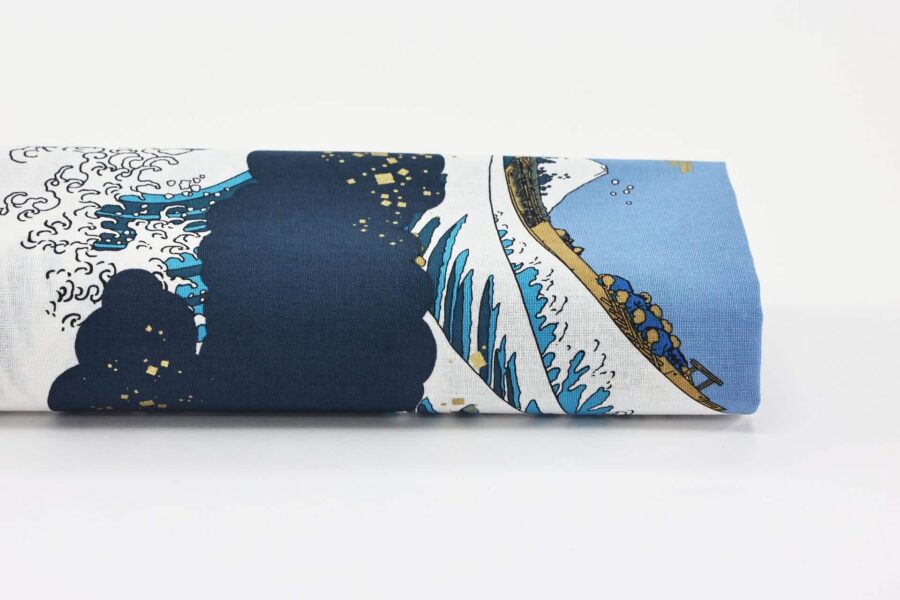
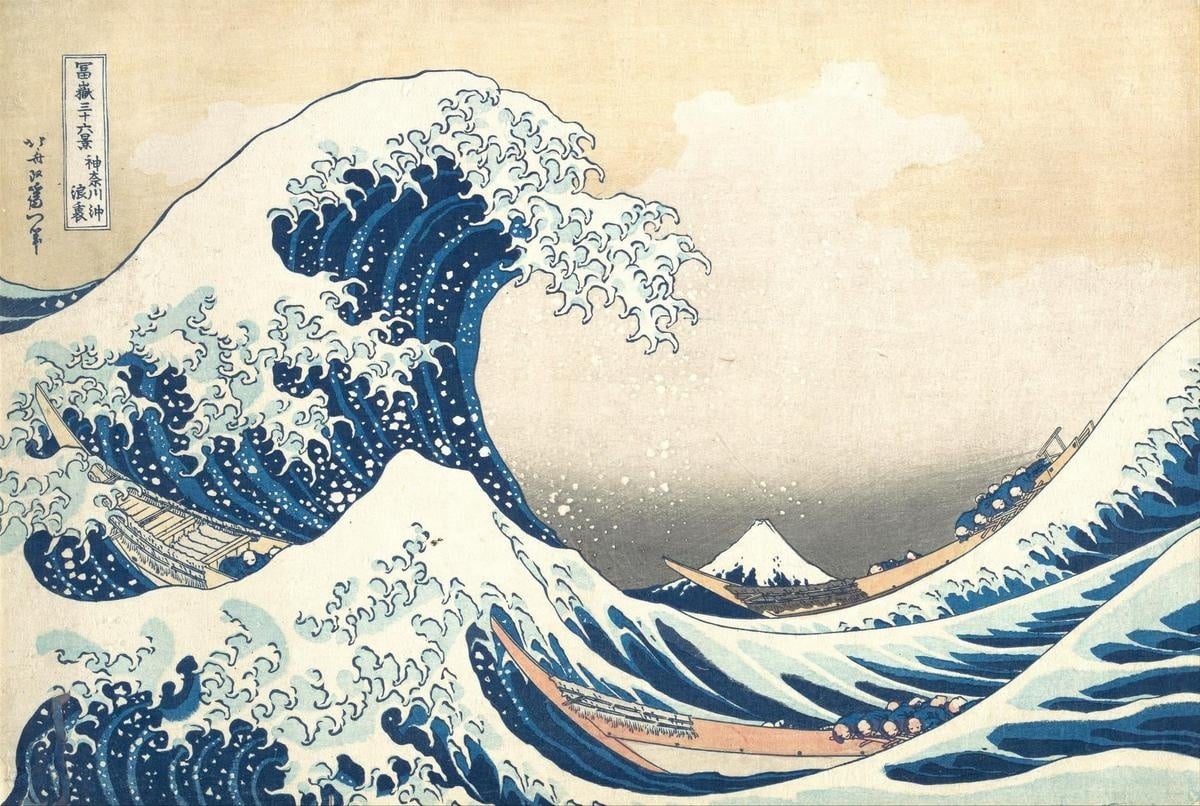
Aranami (荒波) translates to “rough waves” or “raging sea.” This is the dramatic, powerful wave that Hokusai made world-famous in Kanagawa-oki Nami Ura (神奈川沖浪裏), “The Great Wave off Kanagawa,” published around 1831. Aranami is all movement, foam, and energy. The Ukiyoe Kanagawa wave fabrics in our collection capture this dynamic quality.
Now, here’s an important distinction: Hokusai’s Great Wave is not seigaiha. It gets used to illustrate articles about seigaiha surprisingly often, but the two couldn’t be more different. Seigaiha is calm, geometric, and endlessly repeating. Hokusai’s wave is violent, singular, and frozen at the exact moment before crashing. Using one to represent the other is like using a storm photograph to illustrate an article about a mountain lake.
Yabure seigaiha: when the wave breaks
Yabure seigaiha (破れ青海波) means “broken seigaiha.” It’s a variation where parts of the concentric arcs are deliberately interrupted or fragmented. The effect is subtler, more organic, and less formal than standard seigaiha. Yabure seigaiha appears on nagajuban (長襦班), the full-length kimono undergarment, and on casual items where a less rigid aesthetic is preferred. It can be worn year-round, while standard seigaiha is particularly associated with summer and New Year’s celebrations.
For a broader look at Japanese geometric pattern fabrics, including seigaiha, asanoha, shippo, and kanoko, the variety of traditional Japanese motifs is genuinely staggering.
How to choose seigaiha fabric
If you’ve read this far, you probably want to actually sew something. Good. Seigaiha is one of the most versatile traditional patterns to work with, and choosing the right fabric depends on what you’re making.
Classic seigaiha: pure pattern
The most traditional seigaiha fabrics feature the wave pattern alone, in a single color on a contrasting background. This is where you’ll find the widest range of base cloths:
- Quilting cotton (110 to 120 gsm): the workhorse. Sevenberry Seigaiha fabrics are printed on medium-weight quilting cotton, ideal for patchwork, pouches, and accessories. Sevenberry is a well-known Japanese brand with consistently tight weave and sharp print definition.
- Shantung cotton: slightly textured, with a subtle slub that gives a woven, almost handmade feel. The Shantung cotton Seigaiha in blue is a particularly elegant option for cushions or lightweight bags.
- Dotted variations: some seigaiha prints add small dots within or around the wave arcs, creating a softer, more intricate look. The Seigaiha dotted duck blue and dotted red versions are popular choices.
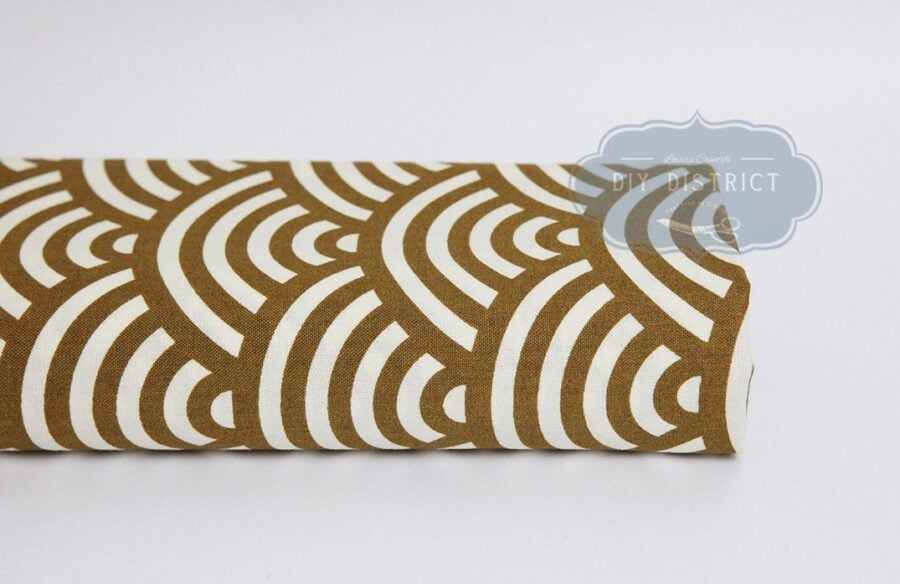
- Bold scale: for projects where you want the pattern to be immediately recognizable, the mustard-colored Seigaiha has larger-scale arcs that read clearly even from a distance.
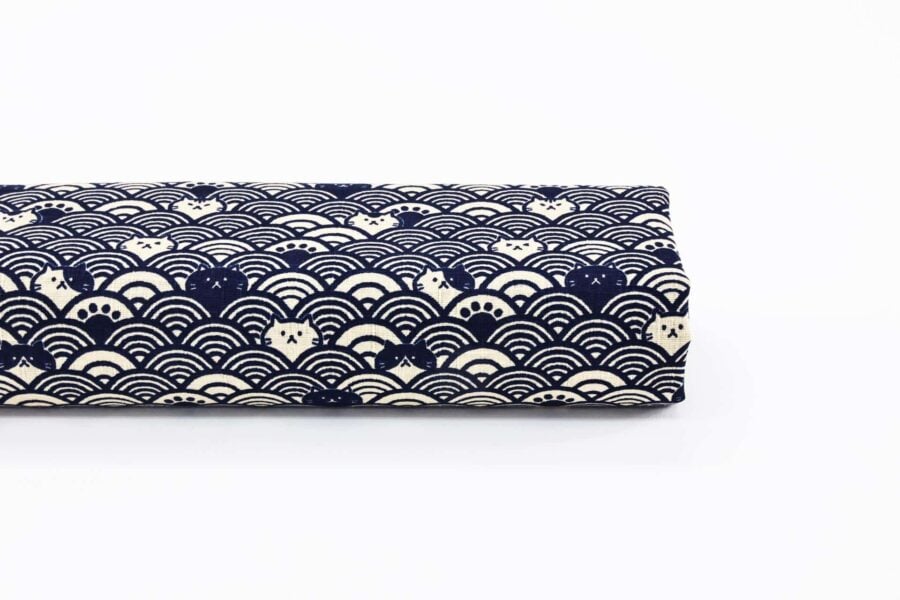
Maneki Neko seigaiha blue beige fabric
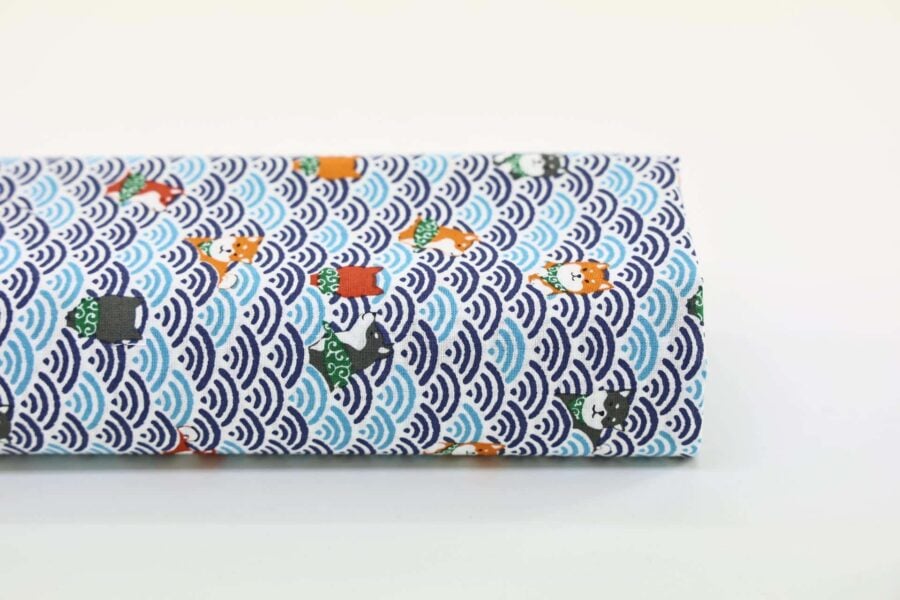
Kawaii Shiba fabric with blue seigaiha waves
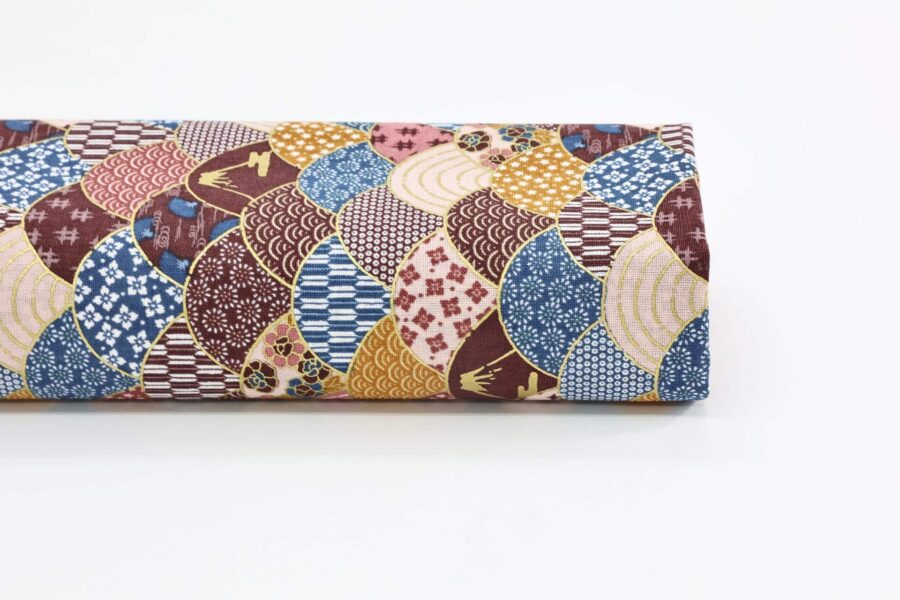
Fabric waves multi-patterned in blue, brown, and orange
Kawaii mashups: seigaiha meets characters
Japanese fabric designers love combining traditional patterns with playful motifs. Seigaiha serves as a background for all kinds of characters:
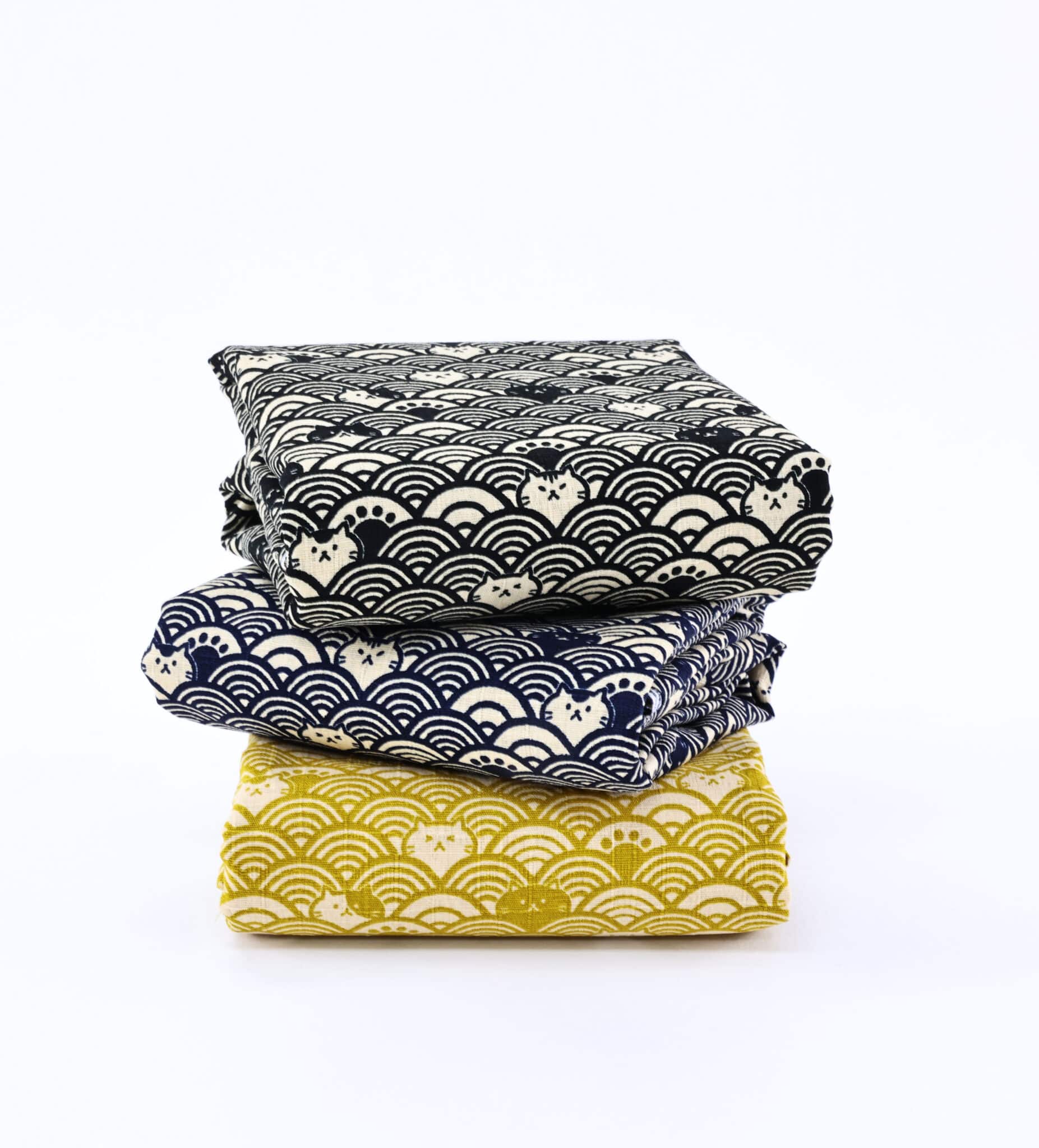
- Maneki Neko (lucky cat) on seigaiha: the lucky cat waving on a background of fortune waves. Hard to get more auspicious than that.
- Kawaii Shiba dog on seigaiha: playful Shiba inus against a traditional wave background. Perfect for pet lovers and children’s items.
- Cranes and Kagome on seigaiha: cranes (tsuru) layered with the Kagome basket-weave pattern and seigaiha waves. Three auspicious motifs in one fabric.
- Rabbits on seigaiha waves: rabbits hopping across wave crests, a classic Japanese combination found on Edo-period ceramics.
Matching scale to project
A practical tip from years of shipping these fabrics to quilters and sewers worldwide: match the scale of the seigaiha pattern to the size of your finished piece. Small-scale seigaiha (like the dotted versions) works beautifully for pouches, wallets, and small patchwork squares. Large-scale prints need bigger surfaces to breathe: cushion covers, tote bags, furoshiki wrapping cloths, tablecloths, or curtain panels.
For garments, consider the weight. Quilting cotton works for structured pieces like simple jackets or aprons. For flowing garments, look for lighter-weight options.
Whatever catches your eye, a traditional indigo wave, a mustard statement print, or a Maneki Neko riding the waves of good fortune, the full collection of seigaiha fabrics ships directly from Kyoto with over twenty references to choose from.
Seigaiha has been traveling for 1,400 years, from Persian artisans to Chinese cartographers to Heian court dancers to Edo lacquerware masters. Each generation found something new in those concentric arcs. The pattern stayed the same; the meaning kept expanding. That’s not a bad quality for a fabric, either. The same meter of seigaiha cotton can become a wedding furoshiki, a baby bib, a quilted wall hanging, or a book cover, and each time it carries a slightly different story.
What would you make with it?