

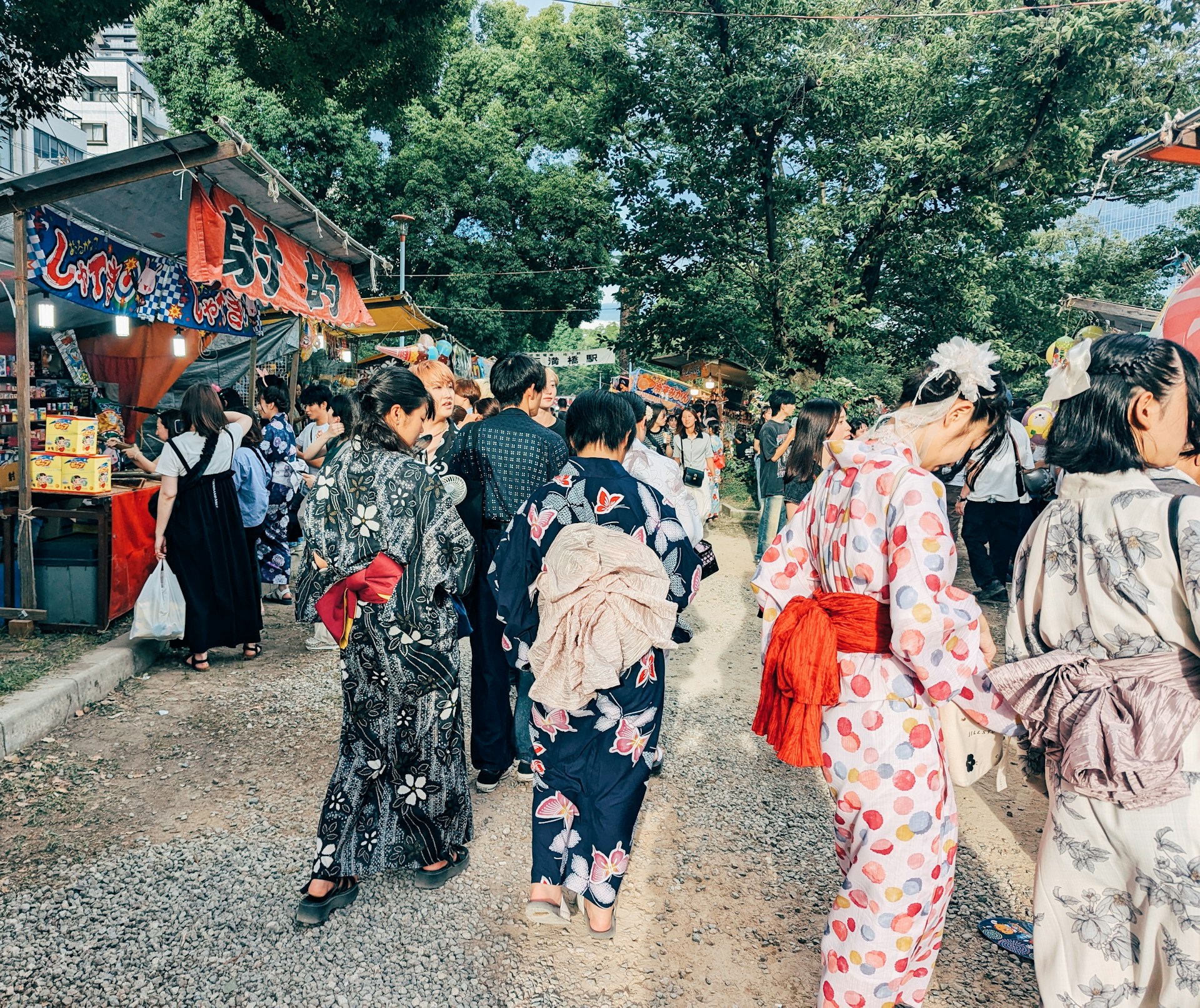
Have you ever noticed those colorful cotton silhouettes filling Japanese streets on summer evenings? That garment is called a yukata. It is the light, casual version of the kimono: a single layer of cotton, no lining, and you can put it on by yourself in a few minutes. In Japan, people wear it to summer festivals and fireworks displays, and after the bath in traditional inns.
We live in Kyoto, a few minutes’ walk from the streets where these garments come out by the hundreds every July. So this guide covers everything customers ask us in the shop: where the yukata comes from, how it differs from a kimono, how to wear one without any faux pas, and which fabric to choose if you feel like sewing your own.
Key points
Before we get into the details, here is what to remember:
- The garment: the yukata (浴衣) is a Japanese cotton summer robe, unlined, far simpler and more casual than a kimono
- Its history: it descends from the yukatabira, a bathing robe worn by Japanese nobles more than 1,200 years ago
- The golden rule: always wrap the left panel over the right; the reverse is reserved for dressing the deceased
- Where to see it: summer festivals, fireworks, inns and hot spring towns; Kyoto’s Gion Matsuri alone draws over a million visitors every July, many of them in yukata
- The fabric: a light cotton, often hand-dyed with old techniques like chusen, still practiced in Hamamatsu
- The price: expect 3,000 to 30,000 yen (roughly $20 to $200) for a ready-to-wear yukata
What is a yukata?
The yukata (浴衣) is Japan’s summer garment par excellence. It is a cotton robe made from a single layer of fabric, with no lining. You wear it directly against the skin or over light underwear. It breathes, even when the Japanese summer climbs past 35 degrees Celsius (95°F).
The other advantage: it is easy to put on. A full kimono requires several layers, accessories, and often a second pair of hands. A yukata goes on by yourself, in under five minutes.
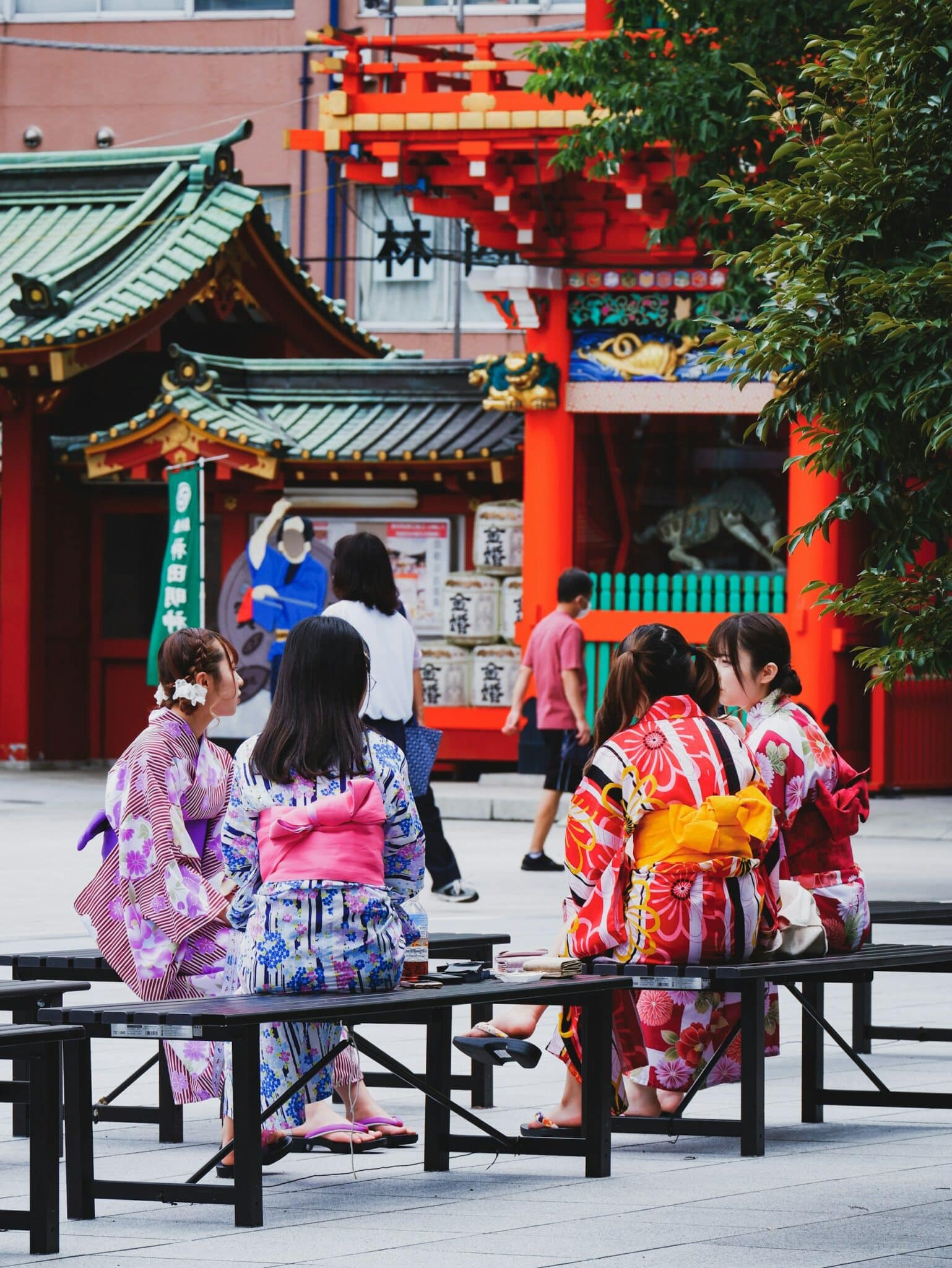
Both men and women wear it. Women’s models are the most colorful: cherry blossoms, morning glories (asagao, “morning faces”, the iconic flower of the Japanese summer), goldfish or fireworks, on indigo, black or white backgrounds. Men’s models stay sober, navy, gray or dark green, often with simple stripes. The cut differs a little too: men’s yukata fall straight to the ankle, while women’s are cut longer, then folded at the waist to adjust the length.
A thousand years of history: from bathing robe to festival wear
The yukata was born in the bath. More than 1,200 years ago, during the Heian period (794-1185), Japanese nobles slipped into a light robe called a yukatabira (湯帷子) to enter the steam bath. People did not bathe naked back then: the robe protected the skin from the scalding steam. The name says it all, yu means bath, and katabira means a light robe.
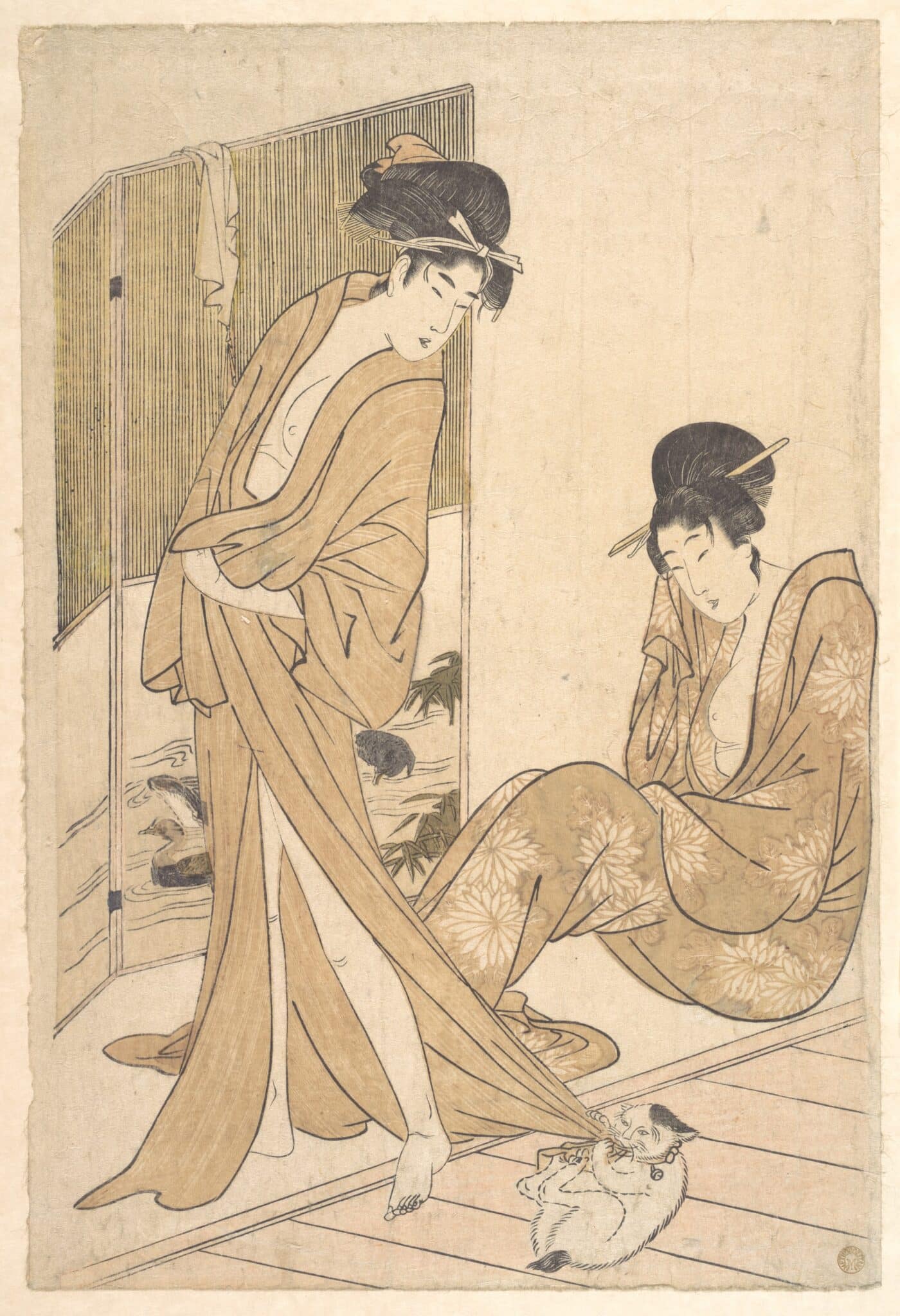
The great turning point came in the Edo period (1603-1868). Public baths became a pillar of city social life, and cotton, finally cheap, replaced hemp in everyday clothing. Kabuki actors played the role of today’s influencers: when one of them wore a striking pattern on stage, all of Edo (the old name for Tokyo) wanted the same. Little by little, the yukata stepped out of the bath. People first wore it on the way to and from the public bath, then as a summer garment in its own right. That is the form that survives today.
At the end of the 19th century, Western fashion pushed traditional clothing out of daily life. But the yukata held on as festival and holiday wear. And it still sells: the Japanese kimono market, which includes yukata, was still worth 224 billion yen in 2023 according to the Yano Research Institute.
Yukata or kimono: how to tell them apart
The short answer: a yukata is cotton, unlined, and worn casually in summer. A kimono is most often silk, lined, and worn for dressier occasions.
| Yukata | Kimono | |
|---|---|---|
| Fabric | Cotton | Silk, most often |
| Lining | None, a single layer | Lined |
| Collar | No second collar | White nagajuban collar shows |
| Obi (belt) | Narrow and soft | Wide, stiff, ornate knot |
| Footwear | Geta, bare feet | Zori over tabi socks |
| Occasion | Casual: summer festivals, inns | Formal: ceremonies, dressy events |
| Season | Summer | Year-round |
| Price (new) | 3,000 to 30,000 yen | From 50,000 yen |
The fastest way to tell them apart is the collar. Under a kimono, you wear an under-kimono called a nagajuban, whose white collar peeks out at the neckline. Under a yukata, nothing: no second collar in sight.
The belt is different too. A yukata is tied with a narrow, soft obi (帯). A kimono calls for a wider, stiffer obi with elaborate knots. Same logic for the feet: wooden geta sandals with a yukata, zori sandals worn over tabi socks with a kimono.
When it comes to price, you should know there are really two markets. A new kimono is a serious investment: 50,000 yen minimum for good quality, and ceremonial silk pieces can pass the million-yen mark. But Japan also has a very lively second-hand kimono market, with vintage pieces in excellent condition for a fraction of the price of new. That is what we offer in our collection of traditional Japanese kimonos: recycled pieces, hand-picked here in Kyoto. The yukata, for its part, stays affordable even new, between 3,000 and 30,000 yen.
Where can you see yukata today?
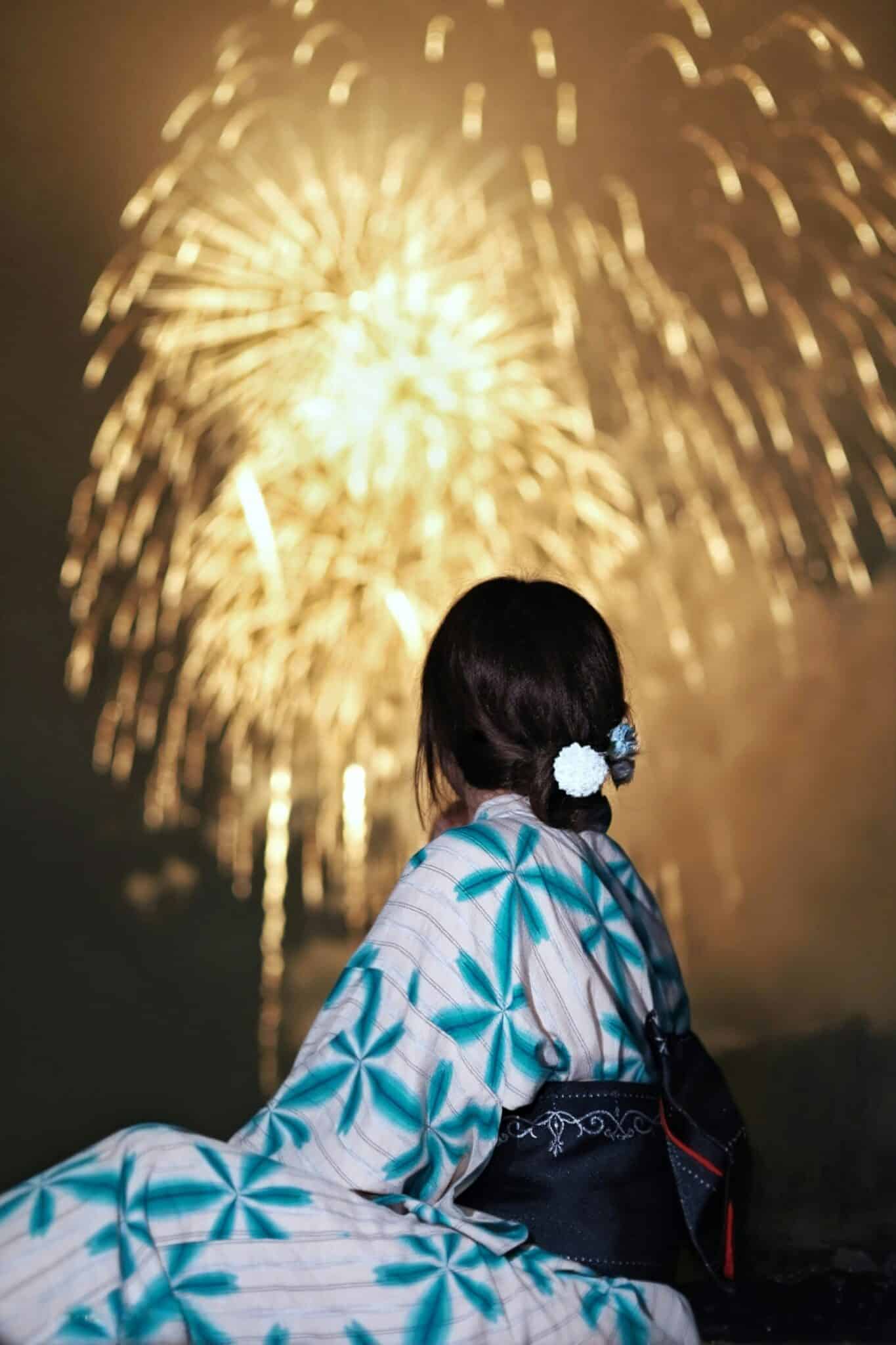
If you want to see yukata culture alive and well, come to Japan between June and September. The classic occasions are the bon odori neighborhood dances, the Tanabata star festival and the fireworks displays. And the biggest stage of all is right here in Kyoto: the Gion Matsuri (祇園祭) takes over the whole month of July and draws more than a million visitors. The streets around Shijo turn into a slow parade of cotton in every color.
Watch the crowd for a moment and you will see a whole social game: groups of friends coordinating their colors, couples in matching patterns, grandmothers adjusting their granddaughters’ obi in two expert moves. At home, it has become a ritual: our two daughters each have their own yukata, bought especially for the matsuri, and they are delighted to bring them out every year when we go out for festival season.
And you do not have to be Japanese to join in. Rental shops all over Kyoto and Asakusa will dress you in a yukata for the day, obi tied and geta included, for a very reasonable price. Nobody will look at you twice: locals are genuinely pleased to see visitors take part in the season.
The other face of the yukata, a more peaceful one, can be found in hot spring towns like Kinosaki or Kurokawa. After dark, the whole town becomes a yukata promenade: inn guests drift from bath to bath in the simple robe their inn lends them, wooden soles clacking on the stone. It feels ordinary when you live in Japan, and it stuns every visitor the first time.
If Japanese textile heritage appeals to you beyond the summer season, our guide to Japanese fabric in Kyoto lists the museums and workshops where you can see this craftsmanship up close all year round.
How to wear a yukata
Wearing a yukata means knowing a handful of rules. Nothing complicated, promise.
The non-negotiable one: the left panel wraps over the right, for men and women alike. The reverse is reserved for dressing the deceased, and getting it wrong at a festival immediately draws embarrassed looks. A trick many Japanese people learn as children: seen from the front, the collar opening should draw the letter “y”, as in yukata.
The obi makes the silhouette. Women tie it at the waist, most often with a bow worn at the back. Men wear it lower, on the hips, with a flat knot at the front or on the side. Without the obi, you have a bathrobe; with it, the garment finds its true line.
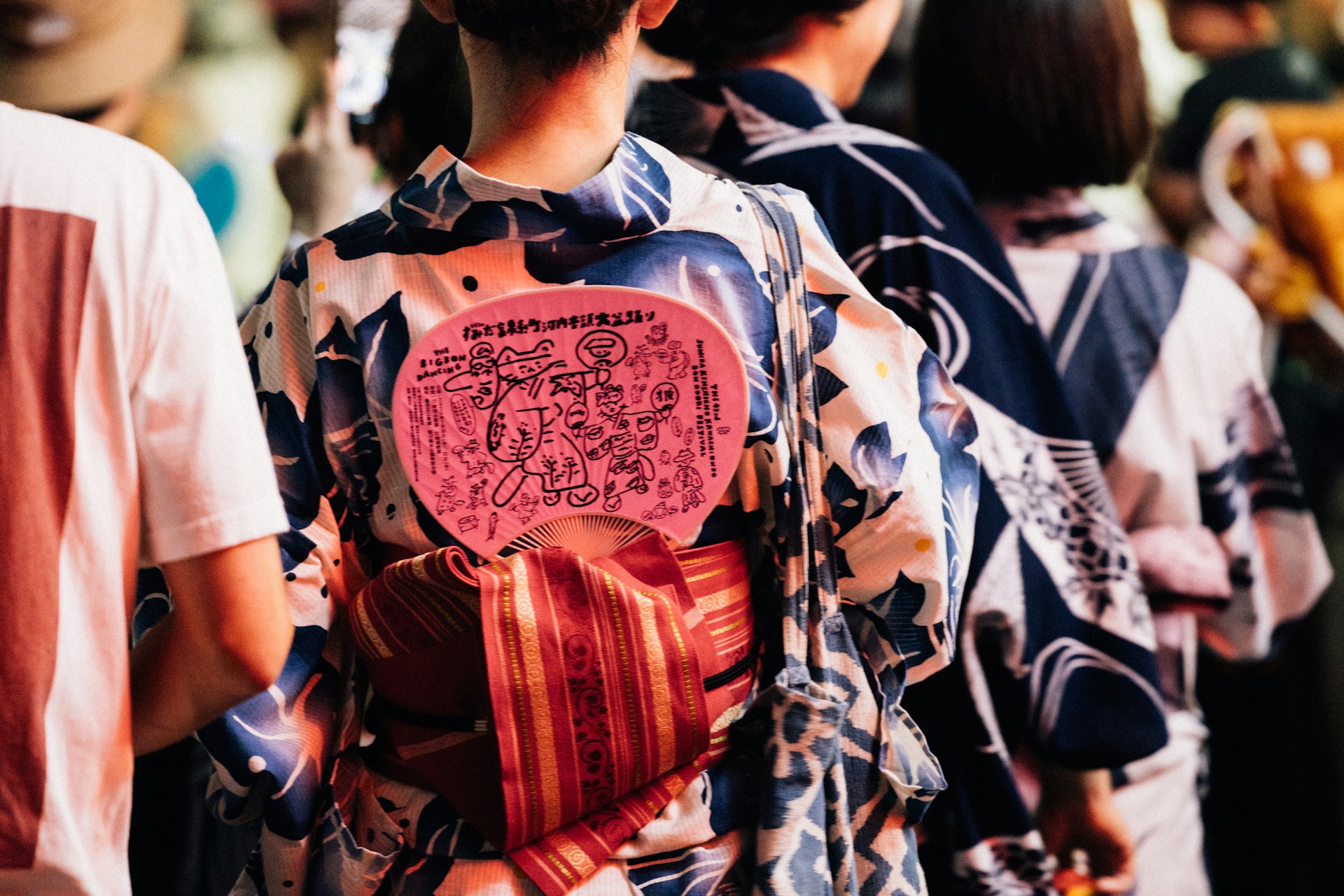
For the rest, simplicity rules. Underneath: a light cotton slip or ordinary underwear. On the feet: geta (下駄), the wooden sandals, with that unmistakable clacking sound that is, for me, the sound of Japanese summer evenings. Slip a flat fan (an uchiwa) into the back of the obi and the outfit is complete. To carry your essentials to the festival, a handmade knot bag in matching cotton rounds off the look.
Which fabric for a yukata?
Yukata cotton is no ordinary cotton. It is light, so you can breathe through the humid heat of August nights, yet dense enough to drape well. And it is often dyed by hand, using techniques refined over centuries.
Chusen, the dye of Hamamatsu
The star technique is called chusen (注染), literally “poured dyeing”. The fabric is folded accordion-style, a stencil lays down a paste that protects certain areas, then liquid dye is poured over the whole stack while a pump pulls it through every layer at once. The result: fabric dyed identically on both sides, with soft gradients no industrial printing can imitate.
The historic center of this craft is Hamamatsu, between Kyoto and Tokyo. A hundred workshops once worked there; only a handful remain, like the Nihashi Somekoujyo workshop, founded in 1927, which still does every step by hand. A cousin technique, katazome (stencil dyeing, classically in indigo), is even older and gives crisper lines. Those same sturdy indigo cottons are the traditional ground for sashiko embroidery, if you like to decorate your fabric by hand.
Cotton or polyester?
An honest note in passing: modern yukata in breathable polyester have become a serious option. They wick sweat well, keep their shape and dry fast. Cotton breathes more naturally and gets lovelier with age, but the purist position is getting hard to defend. A well-made polyester yukata has nothing to do with the costume versions sold to tourists.
Sewing your own yukata
This is the question our sewing customers ask us most, and the answer is yes, you can absolutely sew your own. The right fabric is a light cotton, around 100 to 130 g/m², with a tight weave and crisp pattern edges. You will find the cotton fabric to sew your own yukata in our seersucker selection.
Our first recommendation: Japanese seersucker, a puckered cotton also called shijira-ori (しじら織). Its textured surface holds the fabric slightly away from the skin, which keeps you cool even without a breeze. Our seersucker goldfish fabric on a white background and Asanoha seersucker fabric on a blue background are made for exactly this. If you love traditional geometry, the Asanoha shibori fabric on light blue and the Sevenberry seigaiha waves in navy blue belong to the same family of patterns; the asanoha pattern and the seigaiha pattern each have their own guide on the blog. A few of our favorites:
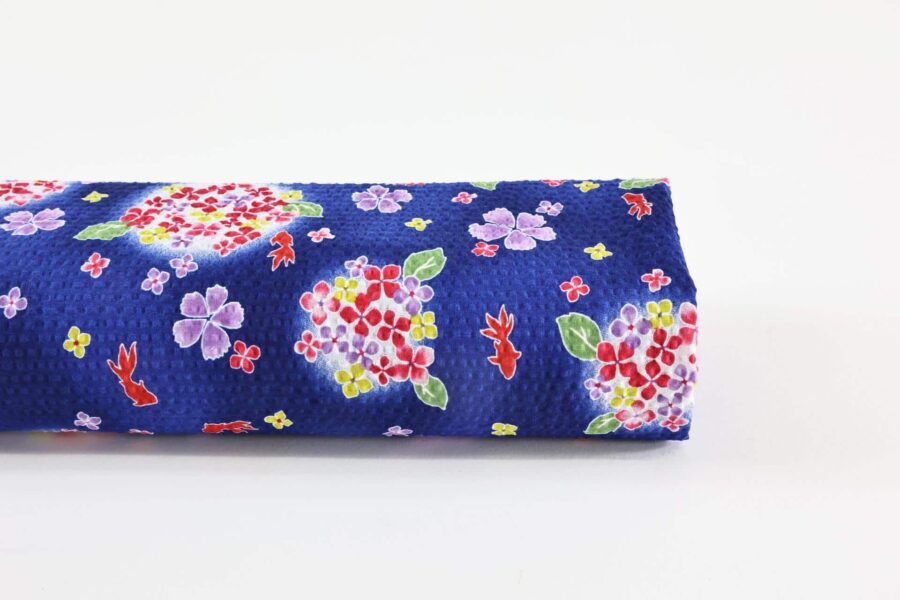
Japanese seersucker goldfish fabric navy blue background
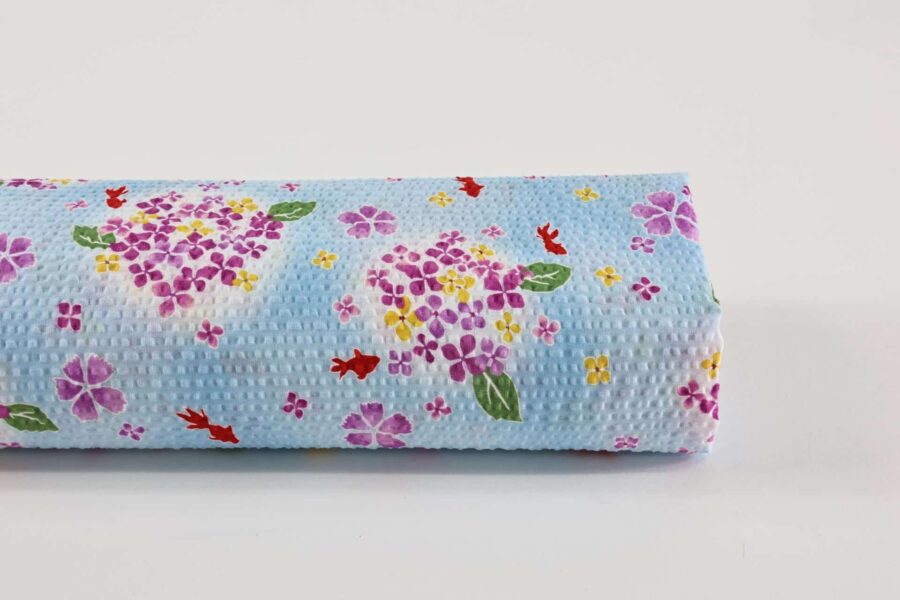
Japanese seersucker goldfish fabric light blue background
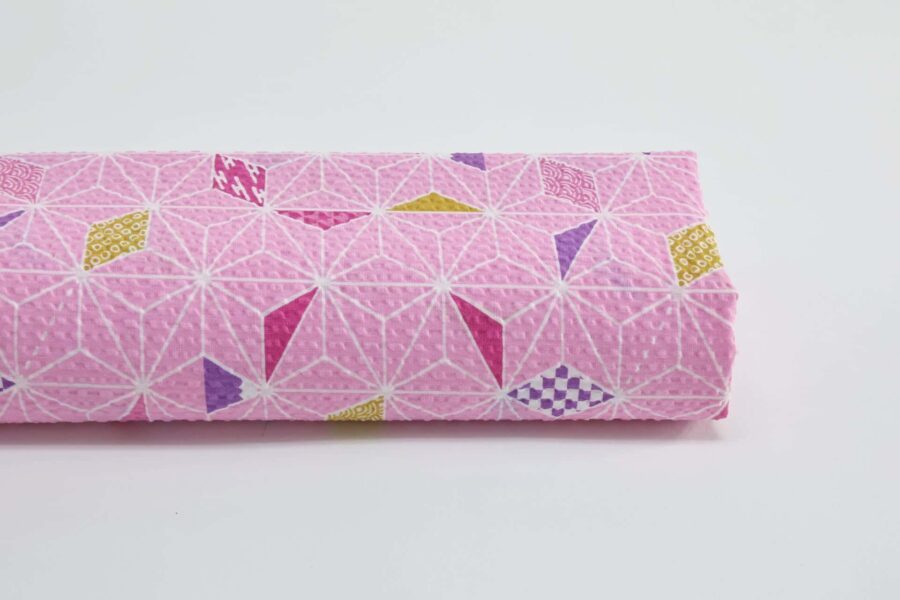
Japanese Asanoha seersucker fabric pink background
Care and storage
Good news: a cotton yukata is easy to care for, especially compared to a silk kimono. Hand-wash in cold water for your finest pieces, gentle machine cycle for everyday ones. Hand-dyed fabrics bleed a little in the first washes: that is normal, just wash them separately two or three times.
Dry flat rather than on a hanger, because the weight of wet cotton can pull the garment out of shape. Iron inside out, on low heat. For storage, fold along the original seams and keep it away from sunlight and humidity until the next summer calls it back out.
Conclusion
A thousand-year-old bathing robe that still rules over 21st-century summers: few garments can say as much. The yukata has survived everything, the arrival of cotton, Western fashion, polyester, because it does one simple thing and does it well. It dresses the Japanese summer.
And it is a garment you experience more than you study. Put one on in a hot spring town, or sew your own from Japanese cotton, and you will understand why it inspires so much affection.
So, what draws you most to yukata culture: the patterns, the history, or the urge to sew one? Tell me in the comments! And if you would rather have a ready-made piece, our selection of vintage yukata and summer kimonos keeps growing as the season warms up.